

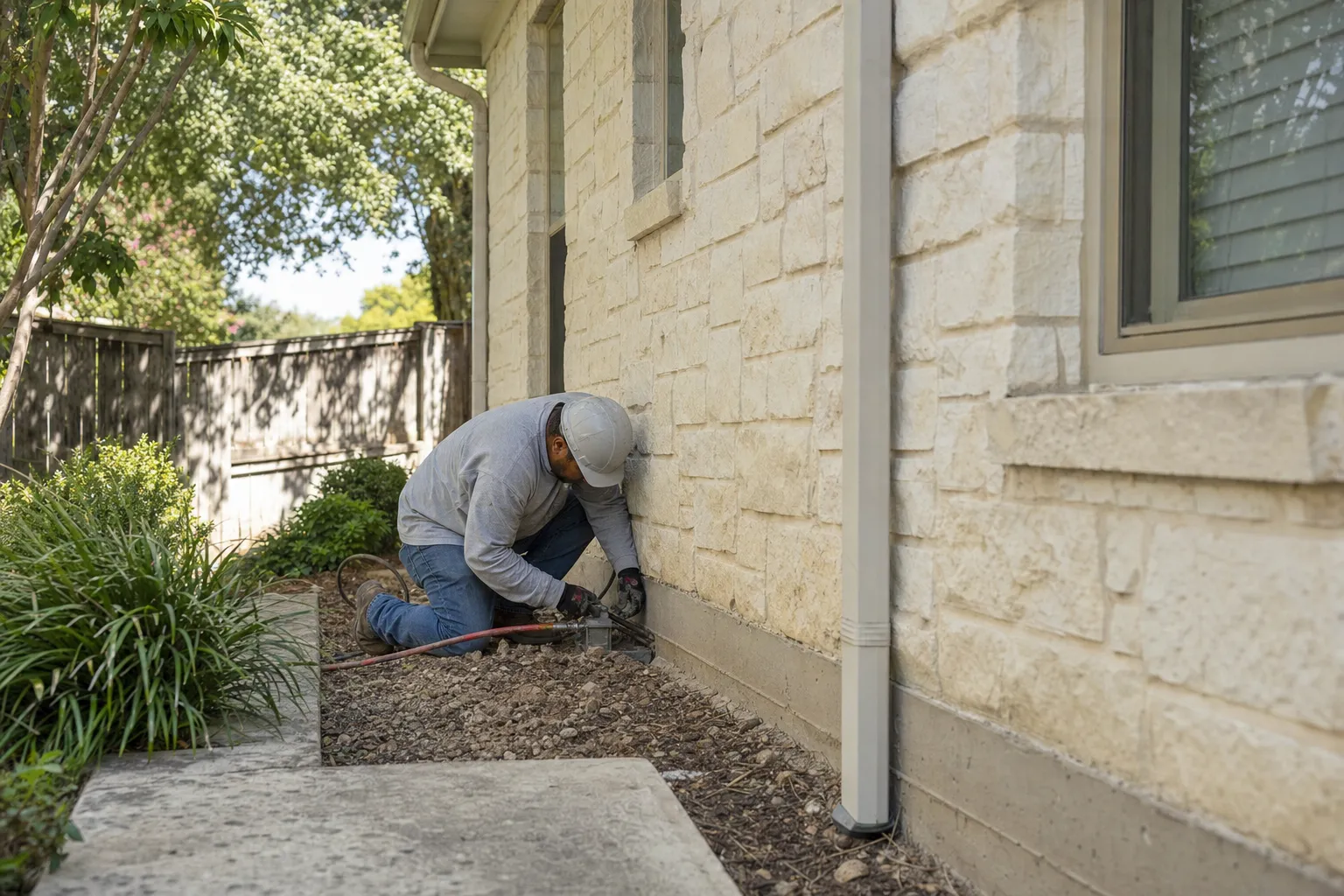
In most cases, your family will NOT need to leave the house during the underpinning process — daily routines can continue while the crew works. Crews work primarily along the exterior foundation perimeter, digging small access pits and driving reinforced concrete piers to stable ground. Most of the home stays fully accessible throughout the job. Noise and vibration are part of any active foundation repair job — the character and intensity vary by equipment type and soil conditions at each pier location. If any interior pier points require a specific room to be cleared, the crew gives advance notice and the restriction lasts only a few hours. Sensitive household members, pets, and very young children may benefit from a brief outing during active work phases, but a full-home evacuation is rarely necessary for a standard concrete underpinning project.
What actually happens inside and outside your home during underpinning?
Concrete underpinning crews work primarily along the exterior foundation perimeter, digging access pits and driving reinforced concrete piers to stable ground. Most of that activity never enters living spaces. The pits are modest in size, spaced at measured intervals along the foundation wall, and they're the main workspace for the entire job.
When interior pier points are needed, crews work in a confined zone — often a hallway, utility room, or corner of the home. Only that immediate area gets cordoned off. The rest of the house stays open and usable.
For deep interior piers beneath a concrete slab, a tunnel may be dug from outside and extended inward. This tunneling approach keeps disruption inside the living space minimal — the crew handles everything from the exterior access point rather than opening up finished floors. All equipment stays outside. Hydraulic rams, pier sections, and concrete materials are staged in the yard.
What does the crew actually do in my yard?
Small pits are excavated at each pier location along the foundation perimeter. Pier sections are driven one segment at a time until the pier reaches refusal — the point where stable, non-moving ground resists further advancement. Controlled pressure is then applied to seat each pier against the foundation, the pit is backfilled, and the crew moves to the next station. Excavated soil is managed on-site throughout. Our crews leave the yard in reasonable order before the job wraps up, and that's something our customers consistently mention.
How much noise and vibration should you expect during underpinning?
Underpinning produces noticeable noise and some vibration — it's active structural work. Most families find it manageable once they know what to expect. The sound profile is distinct, not continuous. The main noise sources are hydraulic equipment cycling and the press driving pier sections downward. Peak noise at each pit location is intermittent rather than constant. Once the crew finishes a station, they move to the next, and sound levels drop between stations. Rooms near the active work zone may carry some vibration during pressing. Rooms on the far side of the home are typically less affected.
Families with infants, shift workers who sleep during the day, or pets sensitive to sound may want to plan brief outings during the most active phases. Before Day 1, ask your crew lead for a rough sense of when the loudest equipment will run each day — that's worth knowing going in, not something to sort out mid-job.
Will the vibration damage anything inside the house?
Properly driven and seated piers lift the foundation gradually. They don't shake it. Pre-existing cracks in drywall or finishes may show minor cosmetic change as the foundation moves back toward level; this can be a byproduct of the correction itself as the structure adjusts. Documenting existing wall and floor conditions with photos before work begins gives you a useful baseline for any post-job comparison. Bring it up with your project lead before the crew starts.
Which rooms might you need to stay out of temporarily?
In most underpinning projects, only the room or hallway directly above an interior pier point needs to be kept clear — and only while the crew is actively working at that location. This is a narrow safety buffer, not a whole-home clearance.
If all pier points fall on the exterior perimeter, no interior room restrictions apply at all. When interior pier access is required, the crew identifies those specific rooms before work begins. You get advance notice, not a mid-project surprise. The family can occupy every other part of the house while that one zone is restricted. Move valuables or fragile items away from the active work zone before the crew arrives — not because damage is likely, but as a simple precaution that removes one more thing to think about on a busy workday. Keep children and pets out of any designated work zone and away from exterior pit areas throughout active work hours.
How far in advance will the crew tell me which areas to avoid?
Before Day 1, ask your project lead to walk through every pier location and access point so you know the full scope upfront. Ask for day-of verbal confirmation before equipment starts up, and find out which zones will be active each day so every adult in the household knows the layout.
Before the job starts, confirm which pier points are interior versus exterior, ask for the expected sequence of work, find out which rooms will be restricted and for how long, and make a plan for children and pets on the heaviest work days.
Are there situations where leaving the home IS the right call?
Most families stay home comfortably, but certain project conditions make a temporary absence the smarter choice — not a requirement, just a practical option worth planning for.
Projects requiring tunneling beneath a large portion of the interior slab involve more activity beneath the floor than a perimeter-only job. On those days, a few hours away from the home is a reasonable call for some families. Families with members who have asthma, allergies, or other respiratory sensitivities should discuss this with the crew lead before work begins. Dust and activity near open access points can be a concern, and a brief planned outing during the most active phases is worth thinking through ahead of time.
Toddlers and crawling infants near open excavation pits are a genuine safety concern. Removing very young children from the home during active pit work is the safest option. Full stop.
On projects spanning several days — which is common for homes with significant settlement along the Blackland Prairie clay perimeter — families typically stay home and work around the crew's schedule. A brief outing on the heaviest work day is easy to arrange once you have the daily sequence. If someone in your household works remotely, talk to the crew lead before Day 1 about when the loudest equipment runs so you can schedule calls and meetings around it.
What questions should I ask before the job starts to plan my day?
Ask for a day-by-day work sequence so you know what to expect each morning. Confirm which pier points are interior versus exterior before the crew sets up. Ask specifically when the hydraulic press will run each day, and how long each active zone will stay restricted — that's enough information to plan meals, naps, and work calls without guessing.
How does concrete underpinning compare to other foundation repair methods for household disruption?
Concrete underpinning is one of the less disruptive foundation repair methods because its primary work zone is the exterior perimeter. Methods requiring extensive interior slab removal or full tunneling create notably more household disruption. Knowing that going in helps you set realistic expectations — and in our experience, that's most of the battle.
For a detailed look at how the method works and what drives it in San Antonio soil conditions, our concrete underpinning in San Antonio page covers the full scope of the process, including what drives pier depth requirements in expansive clay.
MethodPrimary Work ZoneHow much it affects your dayConcrete underpinning (exterior piers)Exterior perimeter pitsLow — most rooms fully accessibleInterior tunneling / slab pier accessBeneath interior slabModerate — dust, blocked pathways, equipment activityPolyurethane foam injectionSurface slab (driveways, patios)Very low — no excavation, same-day usePier-and-beam crawl space repairCrawl space beneath the homeLow to moderate — dust and odors from access hatch
Polyurethane foam injection is the least disruptive method we offer. No excavation, and the surface is usable the same day. It addresses sunken surface slabs like driveways and patios, not deep foundation settlement beneath a home. Concrete underpinning piers driven to refusal reach stable ground unaffected by Blackland Prairie clay's seasonal shrink-swell cycle. The disruption is front-loaded and finite. Once the piers are set, there's nothing left to do in the yard.
What can your family do to prepare before the underpinning crew arrives?
A small amount of preparation before the crew arrives makes the workday smoother for your family and faster for the crew. None of it requires special tools or skills.
Move cars, outdoor furniture, potted plants, and stored items away from the foundation perimeter so crews can reach every pier location without delay. If interior piers are planned, remove furniture and rugs from those specific areas — your project lead will identify exact spots during the pre-job walkthrough. Place pets in a separate room or with a neighbor during active work hours; open pits and hydraulic equipment are hazards for unsupervised animals. Take down items shelved or hung near the most active work zone as a precaution against vibration. Before work begins, confirm which rooms are off-limits and which are fully open so your family can plan meals, work, and rest without having to figure it out on the fly.
Does the crew handle cleanup, or is that on the homeowner?
Our crews leave the yard in reasonable order — yard condition is something our customers consistently mention. Confirm the specific cleanup scope with your contractor before work begins so expectations are clear on both sides.
Why does this matter more for Central Texas clay soils than in other regions?
Central Texas Blackland Prairie clay expands when wet and shrinks sharply when dry. That cyclical movement is what drives foundation settlement in the first place, and it shapes how underpinning work is sequenced and timed. The Austin Clay/Vertisol series found across the Pflugerville and San Antonio service areas is among the most expansive soil types in Texas. Seasonal moisture swings cause measurable heave and settlement at the foundation perimeter. The outer edge of a slab sits on soil that dries fastest during drought — and drops first when it does.
Our crews drive piers to true refusal, the point where stable ground resists further advancement, not to a fixed depth on a chart. Drought years like the severe 2022 drought accelerated soil drying well beyond typical depths, requiring deeper pier placement than a standard regional average would suggest. Summer drought months, roughly June through September, see peak soil shrinkage and the highest volume of settlement symptoms. Scheduling an assessment before or early in that window gives you the most time to plan. Perimeter pier work here commonly spans more than one day partly for that reason: depth requirements in expansive Vertisol can run significantly beyond what shallower soils elsewhere would need.
Most families get through a concrete underpinning project with only minor adjustments to their routine. The crew works the perimeter, the piers go in, and the home stays yours to live in the whole time. Before the crew starts, ask your project lead which rooms are restricted, when the loudest equipment runs, and what the yard will look like at the end of each day. Those are straightforward questions with straightforward answers, and having them in hand before Day 1 makes a real difference.
Schedule a free, no-pressure foundation assessment with our team to get a project-specific picture of your home's pier requirements and what your household's workday will actually look like.