

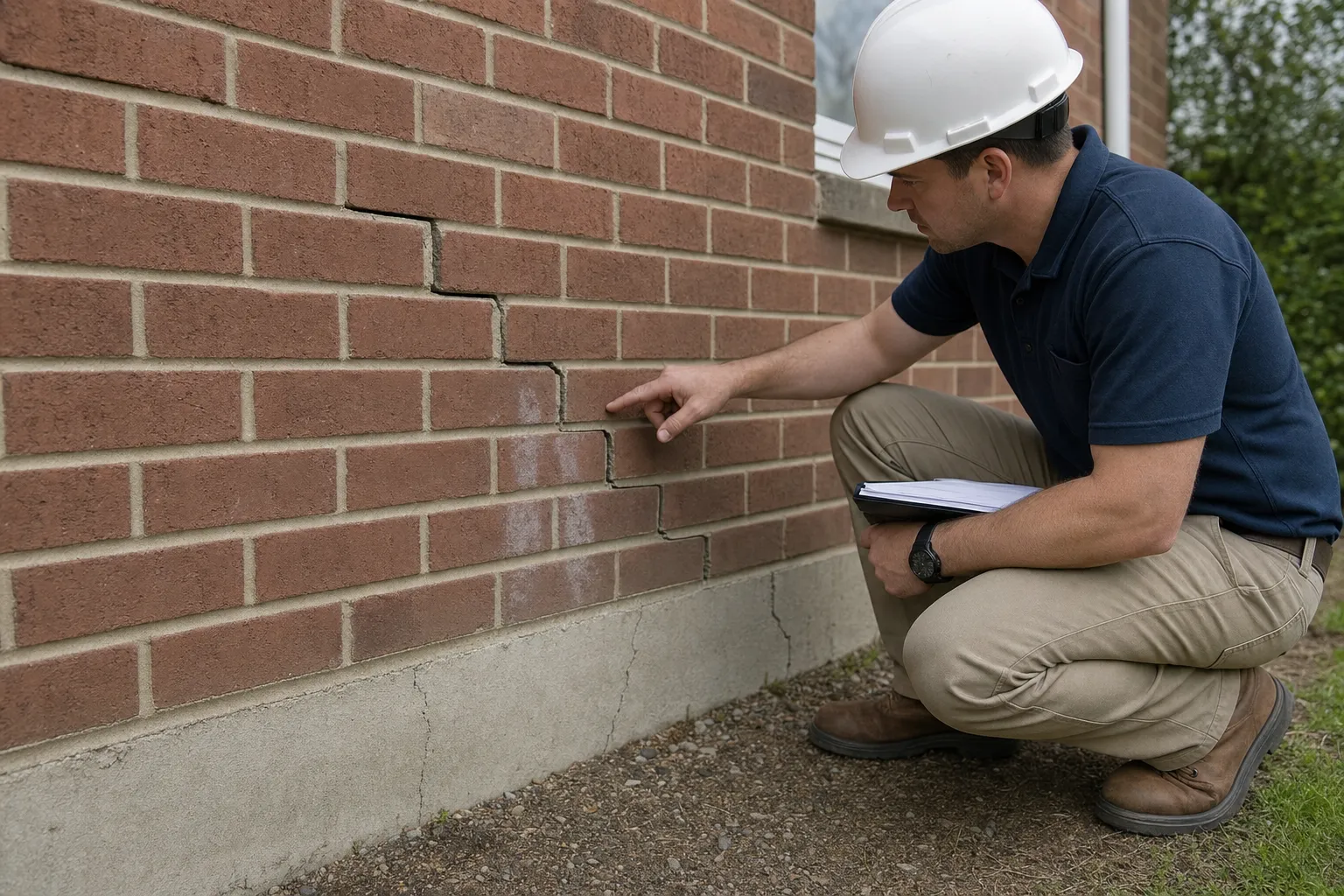
Yes, concrete underpinning fixes sticking doors and growing wall cracks in most cases by treating the root cause rather than the symptoms. Sticking doors and diagonal wall cracks are nearly always caused by differential settlement, where one section of a foundation sinks while the rest stays put, twisting door frames out of square and pulling drywall apart at an angle. Concrete underpinning drives reinforced piers through unstable clay to stable ground below, then lifts the settled section back toward its original elevation. Once the foundation is stabilized, doors typically latch again and crack growth stops. Existing cosmetic damage — drywall gaps, surface cracks — still needs patching after the structural work is done, but the underlying movement is addressed.
What causes sticking doors and diagonal wall cracks in the first place?
Sticking doors and diagonal wall cracks are almost always a symptom of differential settlement — the foundation moving unevenly rather than dropping as one uniform piece. One corner or edge of the slab sinks while the rest stays put, racking the entire structure out of square.
Why do cracks appear at door corners specifically?
A door frame is a rigid rectangle. When one corner drops, the opening distorts into a parallelogram shape. The corner opposite the drop pulls apart under tension, producing the classic 45-degree diagonal crack you see radiating from door and window corners.
Hairline shrinkage cracks look different. They run roughly straight, stay the same width from end to end, and don't grow. Settlement cracks are diagonal, wider at one end than the other, and keep opening over time as movement continues. One is cosmetic; the other is structural — and knowing which you're looking at is the whole question.
In Pflugerville and across the Austin metro, the primary driver is expansive Blackland Prairie clay — an Austin Clay Vertisol series soil that swells when wet and shrinks when dry. Homes built in the early-to-mid 2000s are now entering the age window where this cyclical soil movement becomes pronounced enough to show up as foundation symptoms. Large live oaks and cedar elms make the problem worse during summer. Tree roots extract soil moisture from the clay near the foundation perimeter during drought, creating localized dry pockets that accelerate perimeter drop even when rainfall looks average. June through September historically produces the sharpest soil shrinkage in Central Texas, and that's when new symptom reports peak — we see it every year.
Signs that differential settlement is the cause: a diagonal crack at a door or window corner that's wider at one end than the other; a door that latches on one side of the frame only, or won't latch at all; a floor that slopes consistently toward one corner of the room; a crack that's visibly grown wider since you first noticed it.
How does concrete underpinning actually lift a settled foundation?
Concrete underpinning works by driving reinforced concrete piers through unstable upper clay down to stable ground that seasonal moisture changes can't reach.
What is pressed concrete piling and why is it used in Central Texas?
Pressed concrete pilings are cylindrical concrete sections hydraulically pressed into the ground one piece at a time. They're engineered specifically for expansive clay behavior — the same swelling and shrinking cycle that drives foundation movement across the Pflugerville and Austin area. Because the pilings are pressed rather than drilled or cast in place, the installation relies on the home's own weight as downward resistance, which confirms each pier is carrying real load.
The process starts with small pits dug at calculated intervals along the settled perimeter of the slab, keeping surface disruption as small as possible. Cylindrical concrete piling sections are then hydraulically pressed section by section to refusal — meaning the pier keeps advancing until the surrounding soil is dense enough to stop all further movement. From there, hydraulic jacks transfer the foundation load onto the new piers and raise the settled section back toward its original elevation. The crew monitors the structure during lift to keep the rise uniform. Finally, the foundation is locked at the corrected elevation, pits are backfilled and tamped, and the site is restored.
Engineer-reviewed repair plans confirm pier spacing and depth before any work begins. In Travis County, that review also supports permit compliance — an important protection for homeowners who plan to sell.
Will my doors and windows work normally again after underpinning?
In most cases, yes. Once the foundation returns toward its original elevation, door frames square back up and doors latch without forcing. The frame distortion that caused the sticking came from the slab moving; reversing that movement reverses the distortion.
How soon after underpinning can I tell if the repair worked?
Many homeowners notice doors closing and latching more easily shortly after the lift phase is complete. Full soil reconsolidation around new piers takes longer, but structural stability is established once the foundation is locked at the corrected elevation.
Results depend on how much settlement occurred and how long the structure stayed distorted. Mild-to-moderate settlement caught within a few years typically sees full door and window function restored. Severe or long-ignored settlement may mean frames have taken a permanent set. In those cases, frame or trim adjustments are needed after stabilization — but that's a carpentry fix, not a second foundation repair. The earlier you catch it, the better your odds of full restoration without that extra step.
Drywall and plaster cracks won't seal themselves. They stop growing once movement stops, but the existing gaps still need patching as a separate cosmetic step. Wait until the structure has finished settling into its corrected position before patching. Your contractor can advise on timing based on conditions at your specific home.
For Pflugerville homeowners in ZIP 78660, most homes built in the 2000s and early 2010s are now at the age where first-cycle differential settlement is common. Catching it at first symptom — before frames have been racked for years — gives the best chance of full door and window restoration without additional carpentry work.
Are there foundation problems that concrete underpinning cannot fix?
Concrete underpinning solves differential settlement, but a few conditions require a different approach or additional work alongside piers.
Slab heave is the most important one to distinguish from settlement. When the center of a slab pushes upward — common during wet cycles in Central Texas clay — adding perimeter piers doesn't lower a heaving interior. Heave requires drainage correction and sometimes foam work or interior piers. Misdiagnosing heave as settlement and installing perimeter piers can actually make the problem worse by preventing the perimeter from rising to match the center. We'd rather spend more time on the assessment than put piers in the wrong place.
Post-tension cable failure is a separate structural issue. Many Austin-area slab homes built after the 1980s use post-tension cables running through the slab to hold it together under tension. When a cable breaks, piers can stabilize the slab's position but can't restore the cable's tensioning function. That requires a different repair. Active plumbing leaks beneath the slab keep clay wet and expanding. Installing piers without first fixing the leak means the soil condition driving movement is still present, and new movement can continue around the piers.
Pier-and-beam homes are a different system entirely. Pressed concrete pilings designed for slab foundations aren't the same solution as crawl space support post work for raised pier-and-beam homes. Both address settlement, but the method and access differ significantly.
The inspection step matters before any recommendation is made. Our full concrete underpinning services in Austin page walks through the pier process in detail, but an on-site assessment is what tells us which condition is actually present at your home.
How do I know if my foundation has settled enough to need underpinning?
A combination of visual symptoms and a professional measurement tells you whether settlement has crossed the threshold where underpinning is warranted. Visual signs point you toward the right question. Measurement confirms the answer.
Visual signs worth checking: diagonal cracks at door or window corners that are wider at one end than the other; interior doors that stick or swing open on their own, indicating an out-of-plumb frame; brick veneer with stair-step cracking along mortar joints; a visible floor slope where a marble rolls consistently toward one corner; gaps opening between walls and ceiling or between baseboards and the floor.
Can I wait and watch, or does settlement get worse on its own?
Active settlement in shrinking Blackland Prairie clay accelerates through each drought cycle. The severe 2022 La Niña drought dried Central Texas clay well below normal depth, and many homeowners saw symptoms appear or worsen rapidly in the following seasons. Waiting through another drought cycle typically means more piers are needed, not fewer, and more structural distortion to reverse. We'd rather you call before it gets to that point — early intervention generally means fewer pier points, less excavation, and a better chance of full door and window function without secondary carpentry repairs.
A professional elevation survey mapped across the slab is the standard measurement step. A qualified contractor will take readings at multiple points and explain what the differential indicates — and whether it warrants repair discussion based on your home's size and construction type. Visual symptoms alone can't distinguish settlement from heave or plumbing damage; only an on-site assessment makes that call. In Travis County, structural foundation repair also typically requires a permit. A qualified contractor pulls that permit and provides engineer-reviewed plans, which protects your title and resale position in a market where 70% of homeowners own rather than rent.
What happens during a concrete underpinning job on a Central Texas home?
A typical concrete underpinning job on a Central Texas slab home follows a clear sequence, with the timeline depending on the number of pier points required.
Will the crew have to work inside my house?
Perimeter pier points are accessed from outside the home — no interior disruption for those locations. When interior pier points are needed, our crew tunnels beneath the slab to reach them. Tunneling is cleaner than breaking through a finished floor: the access opening is made from outside, and the living space above stays intact throughout the process. Most homeowners don't expect that going in.
The crew marks pier locations per the engineer-reviewed plan, digs access pits along the perimeter, and sets up hydraulic pressing equipment. For interior points, tunneling begins from the perimeter inward. Concrete piling sections are pressed one at a time, with the home's own weight providing the downward resistance. Each pier advances until it reaches refusal — no estimating, no stopping short of genuine bearing capacity. Once all piers are set, hydraulic jacks raise the settled section while the crew monitors the structure for uniform rise, then lock the foundation at the target elevation. Pits are backfilled and tamped, and landscaping is restored as closely as possible. Yard condition after the job is something customers consistently bring up, and our crew pays attention to it.
After the job, you receive documentation including the engineer-reviewed plan and warranty paperwork. The lifetime transferable warranty on slab pier installations follows the home, not just the original owner. In a market like Pflugerville — where the median home value is $335,500 and 70% of residents are owner-occupants — that transferability is a real asset when you eventually sell.
What should I do after underpinning to protect my foundation long-term?
After underpinning stabilizes your foundation, consistent soil moisture management is the most important thing you can do to slow future movement. The Blackland Prairie clay beneath most Pflugerville slab homes never stops responding to moisture. But you can reduce how dramatically it swings.
A soaker hose system on a timer placed close to the foundation edge helps prevent the sharp dry-shrink cycles that drive settlement. Running it during dry spells — even in winter — makes a measurable difference in clay stability. Gutters, downspouts, and yard grade should direct water away from the foundation. Standing water near the perimeter creates the opposite problem, where clay swells upward and can push the slab rather than drop it. Large live oaks and cedar elms near the foundation pull significant soil moisture during drought, and a certified arborist can advise on root barriers or selective pruning without harming the tree.
Hold off on patching drywall cracks until the foundation has been stable for a reasonable settling period. Patching too early risks hairline re-cracking as the structure finishes settling into its corrected position. Your contractor can advise on appropriate timing. After that, walk the perimeter once a year and note any new diagonal cracks or door changes. Catching something early means a smaller intervention — that's true every time.
Concrete sealing around the foundation perimeter reduces moisture infiltration into the slab edge. Applied as a penetrating sealer to the exposed perimeter concrete, it supports long-term stability by slowing the moisture swings that start at the slab's edge and work inward over time.
Concrete underpinning addresses the root cause of sticking doors and growing wall cracks when differential settlement is the diagnosis. The repair stops new movement, gives doors a real chance to function normally again, and protects the home's structural integrity through future drought cycles.
The right first step is a proper assessment. Symptoms that look identical — sticking doors, diagonal cracks — can come from settlement, heave, or a plumbing leak, and the wrong fix makes things worse. We offer a free, no-pressure foundation assessment to Pflugerville homeowners: an inspector walks through findings on-site and explains what's present before any work is recommended.
Schedule your free assessment before the next drought season peaks. Getting ahead of accelerating soil shrinkage means fewer piers, less disruption, and the best possible outcome for your doors, your walls, and your foundation.