

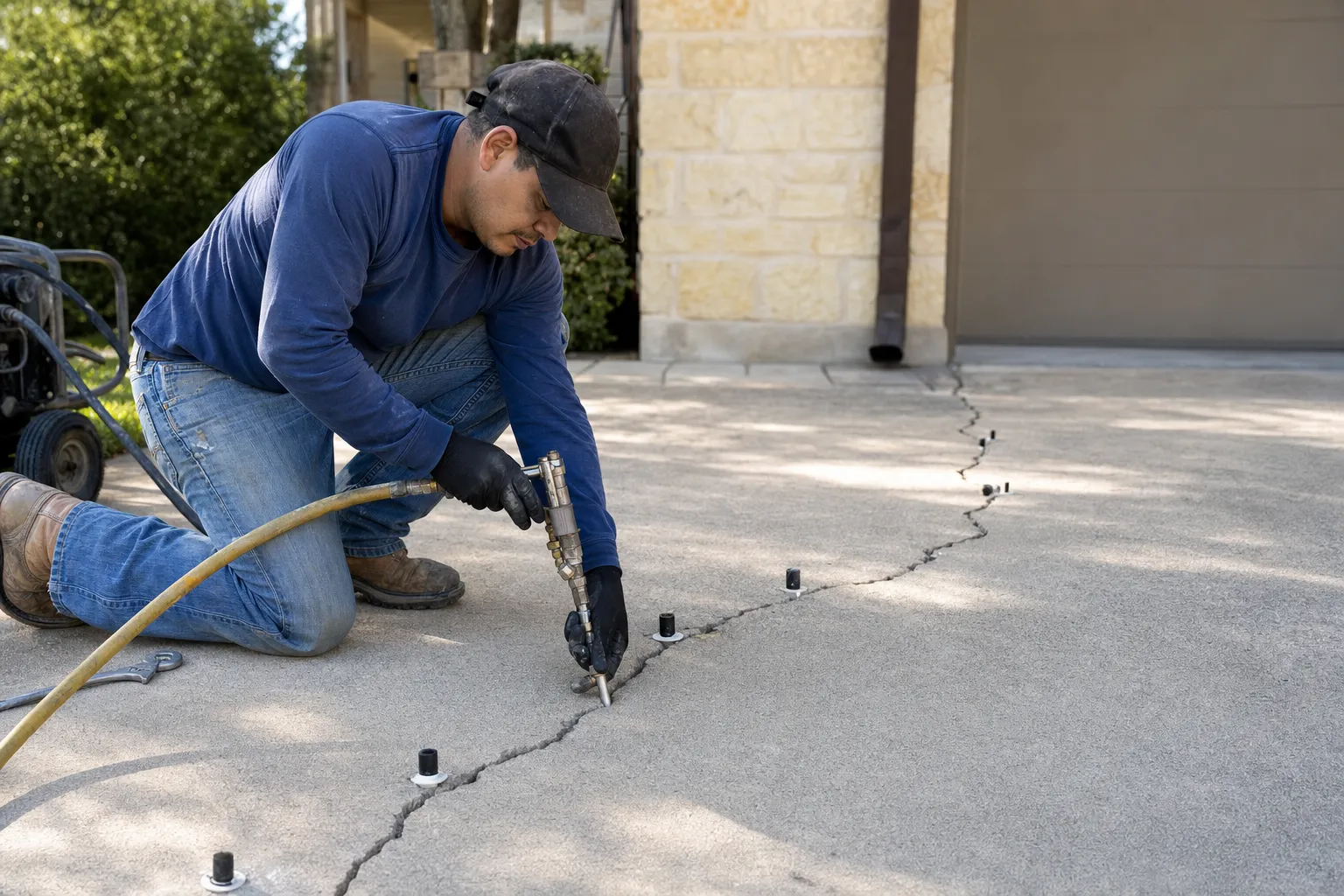
How long does driveway repair take in Austin? Most repairs finish in a single day. Polyurethane foam injection lifts settled concrete slabs in a matter of hours, and the surface is ready for vehicle traffic the same day. Crack repairs are also completed in one visit, though the filled area needs a short cure window before you park on it. The exact timeline depends on how much of the driveway needs work and which repair method fits the damage. Full slab replacement takes longer because of concrete cure time, but targeted repairs are the most common scenario and rarely leave a driveway out of service for more than a day. Knowing which method applies to your situation is the fastest way to set a realistic schedule.
What affects how long driveway repair takes?
The repair method and the size of the damaged area are the two biggest factors controlling how long driveway repair takes. Pick the wrong method for the job and the timeline estimate is meaningless — method drives everything.
Foam injection is measured in hours. Crack filling runs a few hours plus cure time. Full slab removal and replacement stretches across multiple days, mostly because freshly poured concrete needs time to reach structural strength before vehicle weight goes on it.
Surface area drives labor time beyond method alone. A single settling panel near the garage apron takes far less time than a long multi-section driveway where several panels have dropped unevenly. Austin's expansive Blackland Prairie clay soils — the Vertisol series that runs beneath much of the metro and Pflugerville — cause uneven settlement. That means more than one panel sometimes needs attention once our crew assesses the full surface. A repair scope that looks small from the street can widen once we check each joint and transition.
Weather affects sealant and filler cure times, too. Central Texas summer heat from June through September can accelerate surface drying, but high heat may also cause some fillers to skin over before the product cures fully at depth. That's a known failure mode, and we account for it during application.
Does driveway size change the repair timeline?
Larger driveways simply mean more square footage to evaluate, drill, inject, or fill. A two-car driveway with three separate settled panels will take longer than a one-car apron with a single low spot. Labor hours scale with surface area, though the cure time after the work is complete stays the same regardless of how many panels were addressed.
| Repair Type | Typical Duration | Same-Day Vehicle Use? |
|---|---|---|
| Polyurethane foam injection | A few hours | Yes |
| Concrete crack repair | A few hours + cure window | Usually yes |
| Partial slab replacement | 1–2 days + cure period | No — several days |
| Full driveway replacement | Multiple days + cure period | No — several days |
How long does polyurethane foam injection take?
Polyurethane foam injection typically takes a few hours from start to finish, making it one of the fastest driveway repair methods available. No breaking out existing concrete, no waiting for a poured slab to cure.
The crew drills small injection holes through the concrete slab at measured intervals across the settled panel. Foam is then injected beneath the slab through those holes — it expands to fill voids left by soil shrinkage and lifts the panel back toward its original position. Once the target lift is reached, the drill holes are patched.
The foam cures quickly after injection, and the driveway is generally ready for vehicle traffic the same day. We confirm the specific window with each customer based on conditions at the time of the job.
This method works especially well on settled garage aprons and driveway panels across Pflugerville and the broader Austin metro. Clay soil shrinkage creates voids beneath concrete slabs over time, and foam injection addresses those voids directly rather than patching around them. Our crew cleans up the work area before leaving — no torn-up lawn, no debris left behind.
Why does foam injection cure so fast?
Polyurethane foam is a two-component material that reacts and expands rapidly after mixing during injection. The reaction generates the lift and the cure together, so there's no separate waiting period for a poured material to harden. The concrete slab itself never leaves the equation — it's the same slab, just repositioned — so no new concrete cure time applies.
How long does concrete crack repair take?
Concrete crack repair on a driveway usually takes a few hours to complete, but the repaired area needs a cure window before you park on it. The exact window depends on the filler or sealant product used, the ambient temperature at the time of application, and how wide and deep the crack is.
Does crack width change how long the repair takes?
Hairline shrinkage cracks are quicker to address than wider settlement cracks. Wide cracks may require additional preparation steps before filler is applied, which adds time to the visit but produces a repair that bonds and lasts better than simply overfilling a wide gap.
A standard crack repair visit follows four steps. First, we evaluate crack width, depth, pattern, and whether the crack shows signs of active settlement or heave beneath the slab. Then we remove loose debris, dirt, and any previous filler material that has failed, using mechanical cleaning tools so the filler bonds to solid concrete. We apply the appropriate filler or sealant for the crack type, working it fully into the void without trapping air pockets. Finally, the filled area cures for the product-specific window before vehicle traffic returns.
Austin's summer heat can cause filler material to skin over at the surface faster than it cures at depth — and that's one of the more common reasons we see crack repairs fail prematurely here. A professional evaluating crack type and choosing the right product for current temperatures isn't optional. That's what separates a repair that holds from one that needs to be redone within a season.
Crack repair is often paired with joint sealing along control joints and expansion joints. Sealed joints block water intrusion that feeds the clay soil movement driving further settlement.
When does driveway repair take more than one day?
Driveway repair takes more than one day when the damage requires full slab removal and replacement rather than foam lifting or crack repair. Partial replacement means cutting out and pouring a new section, then waiting for fresh concrete to cure before any vehicle can use the surface.
Concrete cure time guidelines from the American Concrete Institute indicate that concrete reaches sufficient strength for vehicle traffic after several days of proper curing, with the full 28-day cure cycle needed for maximum strength. Driving on a freshly poured slab before it reaches adequate strength can cause surface scaling, cracking, and reduced long-term durability. Full driveway replacement adds more time still: demolition of the existing slab, subbase preparation, forming, pouring, and the multi-day cure period all stack together. Plan on the driveway being out of service for at least several days, often longer depending on weather conditions during the cure.
Is driveway replacement faster than repair?
Repair is almost always the faster path when the slab is structurally sound. A concrete slab that has settled due to clay soil shrinkage beneath it but isn't crumbling or deeply fractured is a strong candidate for foam injection rather than replacement. Foam injection finishes the same day. Replacement of that same panel adds days to the schedule and costs more in materials and labor.
Permitting also affects timeline for some structural work. The City of Pflugerville and Travis County require permits for certain concrete and structural repair jobs. Unpermitted work can create title and resale complications, and that's something we take seriously — a reputable contractor pulls the required permits before work begins, which adds scheduling time ahead of the job.
How soon can you drive on a repaired driveway?
After polyurethane foam injection, you can typically drive on the repaired driveway the same day, often within hours of the crew finishing. The foam cures as part of the injection process, so there's no secondary wait for the lifting material to set.
Crack repairs and sealant applications require a cure window. Your contractor should give you a specific timeframe based on the product used and the temperature on the day of the repair. Don't estimate based on surface appearance alone — a repaired crack can feel dry to the touch while the filler is still curing at depth.
Newly poured concrete sections need the longest wait of any repair type. The contractor's guidance on that cure window reflects the actual chemistry of concrete hardening, not a formality. Avoid parking heavy vehicles — trucks, large SUVs — on a freshly repaired section sooner than your contractor recommends, since concentrated weight on a repair that hasn't fully cured stresses the bond between the filler and the surrounding concrete.
Austin's summer temperatures frequently exceed 95°F. High heat makes concrete surfaces feel dry faster, but surface temperature doesn't equal full structural cure at depth. Treating a hot surface as a ready surface is one of the more common reasons driveway repairs fail prematurely in Central Texas.
What happens if you rush the cure time on a driveway repair?
Driving or parking on a repaired driveway before it has fully cured can damage the repair and reduce how long the repair lasts. The damage may not show up immediately, which is part of what makes premature loading such a problem — the repair looks fine on the surface while the bond underneath has already been compromised.
Sealants and fillers that bear vehicle weight before fully setting may crack, delaminate, or compress unevenly. Once a filler delaminates from the surrounding concrete, water enters the crack again. In Austin's clay soil environment, water in a crack feeds the soil movement that caused the crack in the first place.
Fresh concrete sections are particularly vulnerable to premature loading. According to American Concrete Institute curing guidelines, According to the American Concrete Institute's concrete curing guidance, surface scaling and weakened bond strength are recognized consequences of loading concrete before it has cured adequately.. Rushing the cure window often means the same section needs attention again sooner, adding both cost and inconvenience.
In Pflugerville and across Central Texas, clay soil beneath the slab continues to move seasonally. A fully cured repair handles that ongoing stress better than a partially cured one — we've seen rushed repairs fail within a single summer, and it's an avoidable outcome.
How quickly can a contractor schedule driveway repair in Austin?
Scheduling timelines for driveway repair contractors in Austin vary based on the contractor's current workload, the complexity of the job, and whether a prior inspection visit is needed before work begins. Foam injection and crack repair jobs generally don't require special material lead times or multi-crew mobilizations, which can keep scheduling tight for contractors with available capacity. For jobs where the damage is straightforward, the crew can often diagnose and repair in a single mobilization — one visit handles both assessment and the repair itself.
June through September historically see peak inquiry volume in the Austin metro, because summer drought causes clay soil to shrink faster and more visibly than any other time of year. Soil shrinkage peaks during this window, driveway panels drop, and homeowners notice the uneven surface. Lead times with busy contractors can stretch during those months — so if you're seeing movement now, don't wait until September to call.
At Bats Foundation, we offer a free, no-pressure assessment before recommending any work. Our crew walks you through the findings on-site before any repair plan is proposed, and foam injection and crack repair are both completed in a single visit when the scope confirms it during that assessment. Homeowners who want to compare repair methods, understand what drives scope, and plan a repair schedule can find that information through our professional driveway repair in Austin service page, where method options and typical scope are covered in detail.
What to take away about Austin driveway repair timelines
Most Austin driveway repairs — foam injection and crack repair especially — wrap up in a single day with same-day or next-day vehicle access. The repair method and the extent of the damage drive the timeline more than any other factor. Give the repair its full cure window after the work is done. That protects the investment and prevents repeat visits — and in our experience, the homeowners who follow that guidance don't end up calling us back for the same spot twice.