

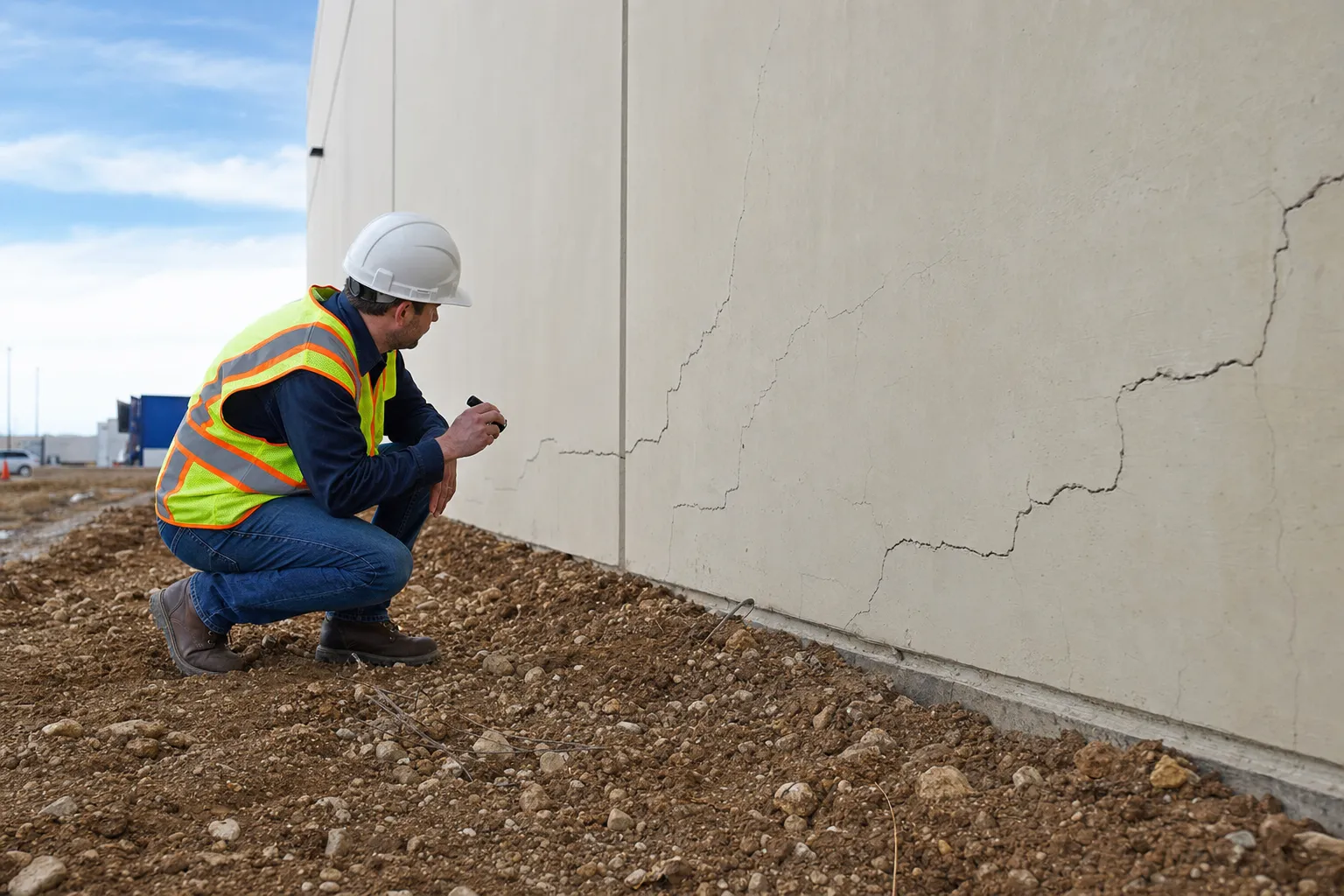
San Antonio's clay soil specifically affects commercial foundations differently than residential ones because commercial slabs cover more ground, carry heavier loads, and present more stress points where shifting soil can cause damage. Bexar County's expansive Blackland Prairie clay is a Vertisol-type soil that swells when wet and shrinks during dry seasons, pushing and pulling at every inch of a foundation. A large commercial slab touches far more of that moving soil than a residential slab does. The weight of equipment, inventory, and upper floors amplifies any movement beneath it. Different soil moisture zones across a wide commercial footprint also cause sections to move at different rates, creating differential settlement — the most damaging type of foundation movement. Residential slabs are smaller and lighter, so the same clay movement produces fewer simultaneous stress points and progresses more gradually.
What makes San Antonio's clay soil so damaging to foundations?
San Antonio sits on Bexar County's expansive Blackland Prairie clay, a Vertisol-type soil that absorbs water, swells upward, then dries and cracks, creating a push-pull cycle beneath any foundation. This soil type is sometimes called "shrink-swell clay" because its volume changes dramatically between wet and dry seasons. The mineral structure of Vertisol clay has a high proportion of montmorillonite, which holds water molecules between its layers and expands when moisture is present.
During wet periods, the clay absorbs moisture and pushes upward against the slab. That upward force is called heave, and it can be powerful enough to lift sections of concrete. During San Antonio's dry summers, the clay loses moisture and contracts, pulling away from the foundation and leaving voids where soil support used to be. We've seen that void space open up faster than most property owners expect — sometimes within a single dry season.
What is Blackland Prairie clay and why does it move so much?
Blackland Prairie clay is the dominant soil series across a wide band of Central and South Texas, including most of Bexar County. The clay is dark, dense, and nutrient-rich. Good for farming. Genuinely difficult for foundations. Its high shrink-swell capacity means the soil volume can shift measurably within a single wet-to-dry cycle.
When clay beneath a slab dries unevenly — as it almost always does, because moisture never leaves soil perfectly uniformly — sections of the foundation drop while others stay supported. That uneven movement, repeated every season, steadily stresses the concrete. A foundation in this region never rests on truly stable ground without engineered support reaching below the active clay layer. That's not a scare tactic; it's just the geology here.
Why does slab size make commercial foundations more vulnerable than residential ones?
A commercial slab covers far more ground than a residential one, which means more of its surface is in direct contact with shifting clay. More contact points means more places where stress can build. When clay heaves or settles beneath a small residential slab, the entire slab may rise or drop as a more unified section, limiting the number of high-stress zones.
A large commercial slab stretches across varying soil moisture levels simultaneously. Soil near a downspout stays wetter than soil under a covered loading dock. Soil along a sun-exposed south wall dries faster than soil in a shaded interior zone. Those moisture differences cause different sections of the slab to move at different rates. Here's how that progression tends to unfold: seasonal rain or drought shifts moisture levels in the Blackland Prairie clay beneath the slab; different areas hold different moisture levels depending on drainage, shade, and coverage; sections with less soil support sink while other sections remain stable, creating mismatched elevations; and the concrete stretches across those mismatched elevations and cracks at the points of greatest tension, often diagonally at corners or along load-bearing lines.
Every additional foot of slab perimeter is another edge where clay can push, pull, or separate from the concrete. A 20,000-square-foot commercial slab has many times the perimeter exposure of a 2,000-square-foot home — and many times the opportunity for differential movement to begin.
How do heavy commercial loads make clay soil movement worse?
Commercial buildings add weight from equipment, stored inventory, multi-story structures, and vehicle traffic. Those loads press the foundation down into clay that's already moving, magnifying the damage from any soil shift. A residential slab bears the weight of furniture, occupants, and the structure above — relatively modest loads spread across the slab.
A warehouse, retail center, or multi-story office building concentrates far heavier loads, sometimes in very specific zones. Racking rows in a warehouse focus weight along narrow strips of floor. Mechanical rooms house HVAC units, water heaters, and electrical gear that can weigh thousands of pounds in a single room. These concentrated loads create what engineers call point loads — areas where downward pressure on the slab is much higher than the surrounding floor. When clay beneath a heavily loaded zone dries and shrinks, the foundation loses soil support exactly where it needs the most. That combination of high downward load and reduced soil support below is a primary driver of cracking and structural distress in commercial foundations.
Do vehicle and forklift traffic make commercial foundation damage worse?
Vehicle and forklift traffic add dynamic loads — forces that shift and repeat rather than sitting still. Each pass of a loaded forklift over a slab that already has reduced clay support below creates a flex cycle in the concrete. Concrete handles steady compression well, but it's far less tolerant of repeated flexing. Over time, those flex cycles open small cracks, allow moisture into the slab, and accelerate the rate at which differential settlement becomes visible damage. Loading dock aprons are among the first areas to show cracking in commercial buildings on expansive clay — we see it routinely. They bear the weight of delivery trucks repeatedly pulling in and backing out, day after day.
What warning signs of clay soil damage look different in commercial buildings versus homes?
Commercial buildings often show clay soil damage through floor-level symptoms first — uneven concrete floors, cracked loading dock aprons, sticking overhead doors, and diagonal cracks in masonry walls — while residential signs tend to appear more slowly and at lower severity. In a commercial setting, an uneven floor isn't just cosmetic. It creates safety hazards, affects racking stability in warehouses, and can trigger ADA compliance concerns in public-facing businesses.
Large expanses of commercial concrete flooring make differential settlement more visible operationally. A significant elevation drop across a large warehouse floor affects equipment movement, pallet stability, and worker safety in ways that the same drop across a typical home simply doesn't.
| Commercial Warning Signs | Residential Warning Signs |
|---|---|
| Uneven concrete warehouse or retail floors | Sloping or bouncy interior floors |
| Cracked or sunken loading dock apron | Cracks along drywall corners near doors |
| Sticking or misaligned overhead roll-up doors | Sticking interior doors and windows |
| Diagonal or stair-step cracking in masonry panels | Brick veneer stair-step cracking |
| Visible slab separation at column bases | Gaps between walls and ceiling or floor |
Tilt-wall and masonry commercial buildings may show horizontal or stair-step cracking in panels earlier than wood-framed residential structures. Wood framing has some flex that absorbs minor movement before it becomes visible. Concrete masonry and tilt-wall panels have almost no flex, so soil movement transfers directly into visible cracking. Residential symptoms — sticking doors, diagonal drywall cracks at corners, gaps between walls and ceilings — develop over similar timelines but typically produce less immediate operational or safety risk than the same degree of movement in a busy commercial space.
Why does seasonal drought in San Antonio hit commercial foundations harder?
During extended drought periods, San Antonio's clay soil dries to greater depths and across wider zones beneath commercial slabs, meaning the soil support loss is both deeper and more widespread than what a smaller residential slab typically experiences. Commercial slabs often cover large impervious surfaces, preventing rainfall from reaching the soil near the perimeter. That perimeter zone is the area most prone to seasonal shrinkage, because it's most exposed to surface evaporation.
Large parking lots and paved surroundings funnel water away from the building rather than allowing rainfall to soak toward the foundation edge. A commercial property surrounded by acres of asphalt or concrete pavement cuts off the incidental moisture that would otherwise slow clay drying near the perimeter. Residential yards and landscaping often provide some buffer — grass, garden beds, and mulched areas slow evaporation and allow rainfall to recharge the clay layer near the home's edge. That buffer doesn't eliminate seasonal movement, but it slows the rate at which the clay dries. Most commercial properties don't get that benefit.
Does irrigation around a commercial building help protect the foundation from clay shrinkage?
Controlled irrigation along the perimeter of a commercial building can slow the rate at which clay dries during drought, but irrigation alone isn't a structural solution. Watering must be consistent to prevent rapid wet-dry cycles, which can be as damaging as sustained drought. Uneven irrigation — wetting one side of a building while the other side stays dry — can actually accelerate differential settlement by creating large moisture contrasts across the slab footprint. On commercial properties, a controlled drip system placed evenly around the perimeter is more useful than overhead spray, which loses much of its water to evaporation before it reaches the soil. Even with good irrigation, Bexar County's prolonged drought cycles can desiccate clay below the depth that surface irrigation reaches.
What foundation repair methods are used specifically for commercial buildings on expansive clay?
Commercial foundation repair on expansive clay typically requires engineered pier systems driven to stable ground below the active clay layer, because surface-level solutions can't resist the ongoing seasonal movement of Bexar County soils. The active clay layer is the zone of soil that expands and contracts with seasonal moisture changes. Repair systems must reach below it to find stable, non-reactive material.
Pressed steel pilings are advanced section by section beneath the foundation to refusal — the point at which the piling can no longer be driven forward, indicating it has reached stable soil or bedrock. Schedule 80 steel sections are used for their wall thickness and resistance to lateral soil pressure from expansive clay. Pressed concrete pilings are hydraulically pressed cylindrical concrete pilings engineered for Central Texas expansive clay soils; they're a common choice for commercial applications because they distribute load through the clay column and reach stable material below the active zone. Hybrid steel pier systems combine a steel shaft driven through the active upper soils with high-pressure-tested concrete cylinders driven to refusal — a two-stage approach suited to the deeper active clay zones found beneath large commercial slabs, where the shrink-swell layer extends further down than in typical residential settings. Concrete underpinning places reinforced concrete piers beneath the foundation to reach ground unaffected by seasonal soil movement, used when the building's load distribution requires broad, evenly spaced support points.
For commercial buildings, repair plans are engineer-reviewed to confirm that pier spacing and load capacity match the specific building's structural demands. Property owners weighing their options can review the full scope of commercial foundation repair in San Antonio to understand which pier systems match their building type and soil conditions.
When should a commercial property owner in San Antonio call a foundation specialist?
A commercial property owner should contact a foundation specialist as soon as operational symptoms appear — uneven floors, cracking masonry, sticking doors, or visible slab separation — because commercial clay soil damage tends to progress faster than in residential structures once it begins. Don't wait for the cracks to get worse. By the time they're obvious to building occupants, differential settlement may already be significant enough to require more extensive repair.
For occupied commercial buildings, early assessment also limits liability. An uneven floor in a public-facing business is a safety and compliance issue, not just a maintenance item. Building owners who delay inspection after noticing symptoms risk both greater repair costs and potential liability if someone is injured on an unstable surface.
Bats Foundation offers a free, no-pressure foundation assessment — a no-cost, on-site evaluation where our team walks property owners through findings before recommending any work. That assessment lets a property owner understand what's happening beneath the slab before committing to any repair plan.
Is a foundation inspection different for a commercial building than a home?
A commercial foundation inspection covers the same basic observations — floor levelness, crack patterns, door and window alignment — but the scope is wider and the documentation more detailed. An inspector assessing a commercial slab will note load zones, drainage patterns around the perimeter, any visible slab separation at column bases, and the condition of loading dock aprons or drive approaches. For multi-story buildings, the inspection also considers how upper-floor loads transfer down to the slab and whether any column bases show signs of movement. Engineer-reviewed repair plans are especially important for commercial properties because structural demands differ from residential specs, and repair scope must match actual load and soil conditions rather than a standard residential template.
What commercial property owners in San Antonio should take away
San Antonio's expansive Blackland Prairie clay creates a seasonal heave-and-settlement cycle that affects every foundation in Bexar County. But commercial foundations feel that cycle more intensely — greater slab area, heavier loads, and more simultaneous stress points all work against them. Catching commercial-specific warning signs early, especially operational symptoms like uneven floors and sticking overhead doors, and acting before damage compounds is the most practical way to protect a commercial property. Honestly, we'd rather get the call when you first notice something off than after a season of additional movement has made the repair scope larger. Engineered pier systems driven to refusal beneath the active clay layer, backed by engineer-reviewed repair plans, are the standard approach for durable results on expansive Bexar County soils.