

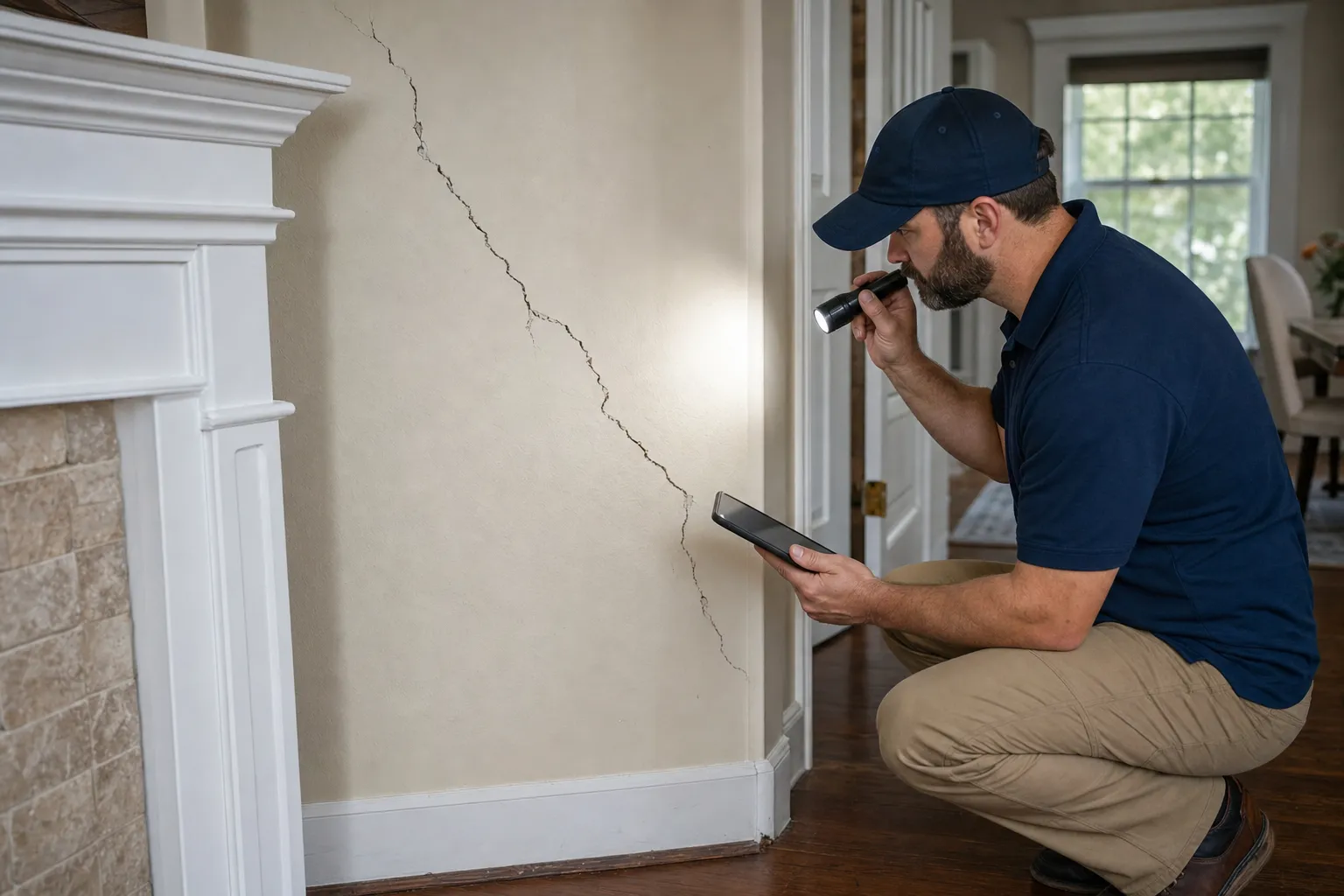
Knowing how to tell if a house actually needs leveling or if the cracks are just cosmetic comes down to counting signs, not examining one crack in isolation. A single small hairline crack is almost always cosmetic. Concrete shrinks slightly as it cures, and drywall shifts with seasonal humidity. The real warning is when two or more signs appear together: diagonal cracks running from door or window corners at a 45-degree angle, doors that stick or swing open on their own, and floors that slope noticeably underfoot. That combination points to differential settlement — one section of the foundation dropping faster than the rest. On Central Texas expansive clay soil, this pattern is common, and it warrants a professional structural evaluation before any repair work begins.
What is the difference between a cosmetic crack and a structural crack?
A cosmetic crack affects only the surface finish — drywall tape, paint, or stucco — and does not mean the foundation beneath it has moved. Structural cracks pass through the full thickness of a wall, widen over time, or show up in several spots at once.
Width tells part of the story. Hairline cracks under about 1/16 inch that stay the same size over months are typically cosmetic. A crack that's wider at one end than the other suggests the foundation has rotated or settled unevenly, pulling the wall apart at an angle. When we see that, the width difference between the top and bottom of the crack is what we're focused on — that's the tell.
Location tells the rest. Cracks that appear above door frames and run at roughly a 45-degree angle toward the corner are a classic sign of corner settlement. Stair-step cracking in brick veneer, where the crack follows mortar joints diagonally up the wall, almost always mirrors movement in the slab or beam directly below that section of the house.
Horizontal cracks in concrete block or brick walls deserve immediate attention. Horizontal cracking means lateral soil pressure is pushing against the wall from outside — that's a different problem from settling, and generally more serious. Don't put that one on your "monitor it" list.
Does crack direction tell you anything useful?
Yes. Crack direction gives you a reliable first clue about what caused it.
| Crack Type | Likely Cause | Action Needed |
|---|---|---|
| Vertical, hairline, uniform width | Shrinkage or normal curing | Monitor over 60 days |
| Diagonal, wider at one end | Differential settlement | Professional evaluation |
| Horizontal in block or brick | Lateral soil pressure | Prompt professional review |
| Stair-step in brick veneer | Foundation movement below | Professional evaluation |
| Spiderweb pattern in stucco | Surface shrinkage | Usually cosmetic; monitor |
Which warning signs mean your house probably needs leveling?
No single sign proves a house needs leveling, but two or more of the following signs appearing together is a strong indicator of differential settlement.
Do sticking doors always mean foundation trouble?
Not always, but sticking doors are worth examining carefully. Wood doors swell slightly in humid weather and shrink in dry weather. That's normal — we see it in almost every house we visit, and it doesn't mean anything on its own.
A door that sticks only during humid months and frees up again on its own is likely responding to humidity, not foundation movement. But a door that sticks in warm, dry weather is harder to explain away. When wood would normally contract, dragging along the top or bottom of the frame in dry conditions points to the frame itself having racked slightly out of square. That happens when the foundation beneath it has shifted.
Doors or windows that swing open or closed on their own carry the same implication. A frame that's no longer plumb will let a door drift in whichever direction the frame tilts.
Why do floors slope in homes built on clay soil?
Sloping floors on a slab home built on Central Texas Blackland Prairie clay are often the result of the foundation perimeter dropping faster than the interior. Clay soil shrinks away from the foundation edge during dry periods, removing support from the outer ring of the slab first.
Here's a five-sign checklist you can walk through room by room:
- Doors stick or swing freely in dry weather — not just during humid months
- Floors slope noticeably — furniture leans, or a marble rolls consistently toward one wall
- Gaps open between the wall and ceiling, or between the baseboard and the floor — the structure is moving in different directions
- Diagonal cracks appear at door or window corners — especially if wider at one end
- Previously patched cracks have re-opened — recurring cracks mean the underlying movement hasn't stopped
If two or more items on that list describe your home right now, the pattern warrants a professional evaluation. We'd rather you call before it gets further along.
Why do Pflugerville homes on clay soil crack more than homes elsewhere?
Pflugerville sits on expansive Blackland Prairie clay, a soil type that — as documented in the USDA Natural Resources Conservation Service Web Soil Survey — swells when wet and shrinks when dry, creating cyclical movement under foundations that other soil types don't produce. This isn't a minor variation. Clay soil in this region can change volume dramatically between a wet winter and a dry summer, pushing and pulling the foundation from below with each seasonal cycle.
Homes built quickly on minimally prepared clay pads — a pattern common during Pflugerville's rapid growth in the early-to-mid 2000s and again after 2015 — can show early signs of differential settlement before the house reaches 20 years old. The median home in ZIP code 78660 was built in 2007, which means in 2026 a large share of local slab foundations are entering the window when perimeter settlement commonly begins to show up as visible symptoms. We're seeing it regularly right now.
Large trees make this worse. Live oaks and cedar elms pull moisture from the soil around foundations during drought, creating localized dry zones that cause uneven settling beneath one side of a slab. The tree side of the house loses soil support faster than the opposite side, and the structure begins to rack. If you've got a mature live oak close to the house, mention it when you call — it changes where we look first.
Does drought make foundation cracks worse?
Drought accelerates the process considerably. When soil dries below normal depth, the foundation perimeter loses support faster than the interior. The classic symptom cluster — sticking doors, diagonal drywall cracks, sloping floors — tends to intensify during and immediately after prolonged dry stretches. Central Texas experiences extended drought cycles that desiccate clay soils well below their normal seasonal depth, speeding up movement that might otherwise take many more years to become visible.
Summer months in Pflugerville, from June through September, are historically when soil shrinkage peaks and foundation symptoms spike. New cracks showing up in August aren't a coincidence.
What is differential settlement and how is it different from normal settling?
Normal settling is when an entire foundation drops gradually and evenly over time. Differential settlement is when one section drops faster or farther than the rest.
Even settling rarely causes visible damage because the whole structure moves together. Differential movement strains walls, frames, and floors because different parts of the house sit at different heights — the structure gets pulled in two directions at once, and the weakest points — door corners, window frames, mortar joints in brick — show the strain first.
The corner of a slab near a downspout that drains poorly, or near a large tree, often drops faster than the center. That corner produces diagonal cracks radiating outward from the door or window frame in that area. The crack pattern maps where the movement started, which is useful when we're figuring out where to focus a repair.
Pier and beam homes experience differential settlement differently from slab homes. Individual support posts can sink into soft soil or rot out over time, causing localized low spots rather than a whole-foundation drop. A single low post produces a soft or bouncy area in the floor directly above it, while the rest of the house stays level.
How do you tell if foundation movement is still active or already stopped?
The most reliable field test is time-based monitoring. Mark the ends of a crack with pencil and write the date next to each mark. Return in 30 days and again at 60 days.
If the crack has grown past your marks, movement is ongoing. If it's stayed within the marks for two full months, the movement may have stopped — though a professional elevation survey is the only way to confirm that. "May have stopped" isn't the same as "has stopped."
A gap between two sections of the house that keeps growing over several months is also clear evidence that active movement hasn't stopped.
Can you test for foundation movement yourself before calling a professional?
A homeowner can do a basic self-check with a marble or a standard 4-foot level, but these tools only confirm that a slope exists. They can't tell you why or how severe it is. Self-checks are useful for gathering information to share with a foundation specialist, but they're not a substitute for a structural evaluation, which measures elevation differences across the full floor plan with a digital or optical level.
A homeowner also can't tell from a visual check alone whether cracks are caused by settlement, heave, shrinkage, or something unrelated to the foundation. That matters because different causes call for different repairs.
Here's a self-check you can complete in under an hour:
- Roll a marble on the hard floor in each room. Note which direction it rolls and in which rooms it moves the most. Write it down.
- Place a 4-foot level on window sills and door headers across multiple rooms. Record which direction each one reads — left-low or right-low — and how far off level each reads.
- Photograph every crack next to a coin for scale. The coin gives any future inspector an immediate size reference.
- Mark each crack end with a pencil and write today's date. Return in 30 days and 60 days to see if any crack has grown past its mark.
- Write down every door or window that sticks, drags, or moves on its own. Note which direction each one sticks and whether the problem appeared recently or has been there for years.
What should you write down before a foundation inspection?
Bring your dated crack photos, your notes from the level checks room by room, and a rough timeline of when each symptom first appeared. That information helps the inspector connect symptoms to the likely sequence of movement and produces a more accurate diagnosis. Homeowners who walk in with notes get a better assessment — we spend less time reconstructing history and more time on the actual findings.
What happens during a structural foundation evaluation?
A structural foundation evaluation measures the elevation of your floor at multiple points, documents crack locations and patterns, and checks doors and windows for signs of frame racking. The elevation survey — taken with a digital or optical level — is the core of any honest diagnosis. It maps the high and low points across the entire slab or pier and beam system, not just the areas where cracks are visible.
Crack patterns are then mapped room by room. The direction, width, and location of each crack tell an experienced specialist where movement originated and which direction it traveled. A crack that starts narrow at floor level and widens toward the ceiling points in a different direction from one that does the opposite — and those details change the repair recommendation.
Exterior inspection covers the foundation perimeter, brick veneer, and any visible gaps between the slab edge and the soil line. Soil that's pulled away from the foundation edge is a meaningful clue: it tells us where the clay has dried out and where the slab has lost lateral soil support.
Do you need an engineer's report before foundation repair?
For permitted structural foundation repair work in Travis County, an engineer-reviewed repair plan adds a documented layer of verification. A licensed structural engineer reviews the findings and the proposed solution before any piers, pilings, or foam injection work begins. This protects you by confirming that the proposed repair method matches what the soil and structure actually need.
Repair plans at Bats Foundation are engineer-reviewed as part of the process. If you want to understand what a thorough evaluation involves before any leveling work is scheduled, the full Austin house leveling evaluation process covers what to expect from diagnosis through repair.
When should you stop monitoring and call a foundation specialist?
Stop waiting and call a specialist when two or more warning signs appear at the same time, when a crack has visibly grown within 60 days, or when a door that used to close freely now requires force.
One sign on its own — a single hairline crack or a door that sticks only during humid months — is worth monitoring but not necessarily urgent. Two or more signs together, especially if they span different rooms or different walls, shift the situation from "watch it" to "get it evaluated." That's just where the line sits after seeing enough of these.
Any crack that's wider at one end than the other, or that shows rust staining from exposed rebar, warrants prompt professional review. Rust staining means moisture has reached the steel reinforcement inside the concrete. That's separate from settlement damage, and it doesn't get better on its own.
In Pflugerville, June through September is when soil shrinkage peaks and foundation symptoms tend to accelerate. Noticing new signs during summer is a prompt to act before the dry season deepens the soil movement further.
Bats Foundation offers a free, no-pressure on-site assessment where the inspector walks you through every finding before any work is recommended — no obligation. Waiting longer rarely makes a repair simpler.
One more practical note for Pflugerville homeowners: structural foundation repair in Travis County generally requires a permit. Unpermitted foundation work can create title and resale complications in a market where 70% of households are owner-occupied and most homeowners plan to sell eventually. Working with a contractor who pulls the proper permits protects that transaction.
The Bottom Line
A single hairline crack is almost always cosmetic. The real signal is two or more warning signs appearing together in the same home. Diagonal cracks at door corners, self-swinging doors, and sloping floors are the three most reliable indicators of differential settlement on Central Texas clay soil. The only way to know for certain whether your house needs leveling is a professional elevation survey — the self-checks in this article gather useful information, but only a structural evaluation can measure the full picture and recommend the right repair path.