

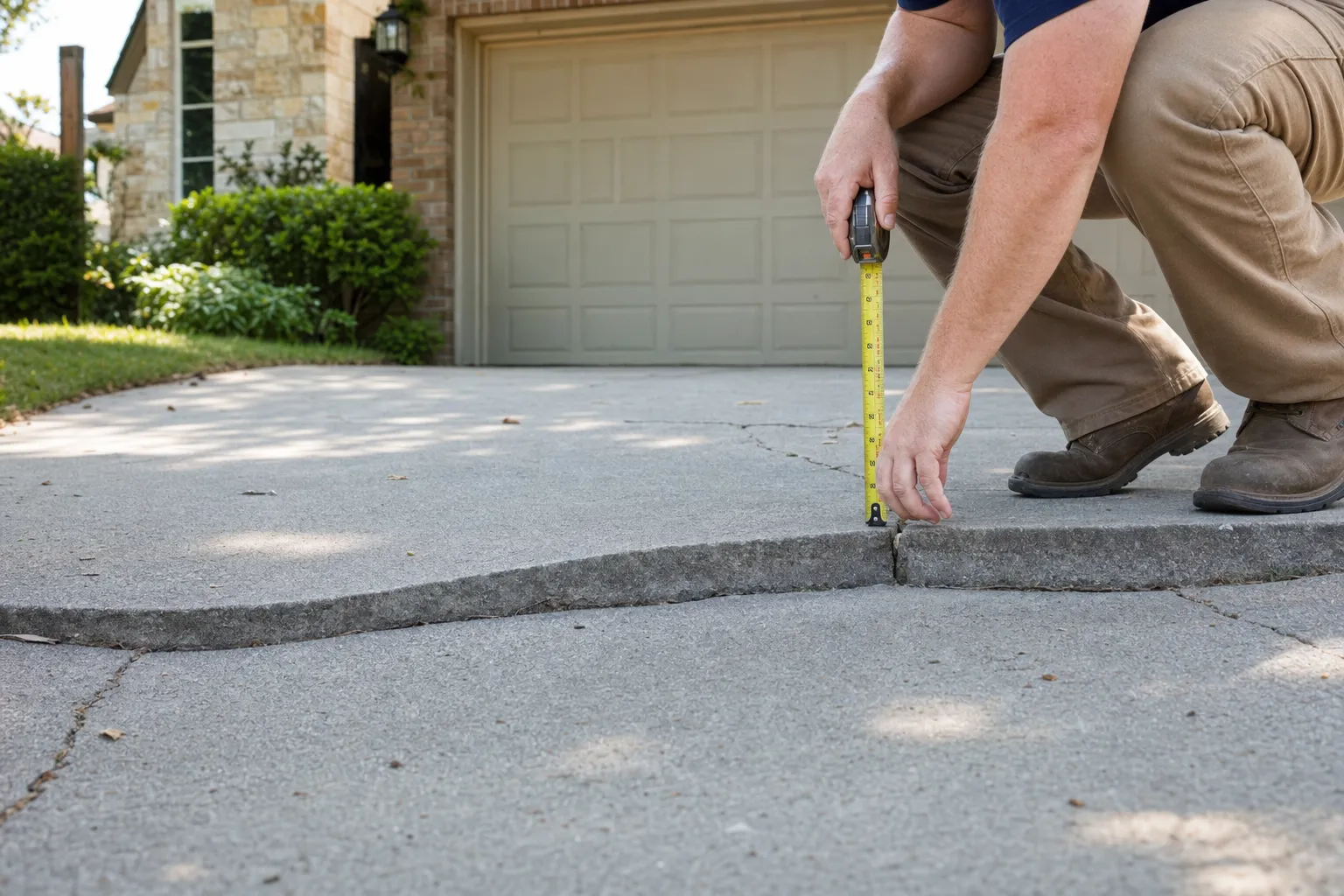
Yes — Austin's clay soil makes driveway problems noticeably worse than most other regions in the U.S. Central Texas sits on Blackland Prairie expansive clay, a Vertisol-series soil that swells significantly when wet and shrinks hard when dry. This swell-shrink cycle repeats every season, lifting concrete slabs during wet springs and pulling away from them during dry summers. Each cycle creates voids beneath the slab. Without support, the concrete settles, cracks, and develops uneven sections. Neighborhoods across the Austin metro — including Circle C Ranch, Avery Ranch, and Pflugerville — share this same soil geology and see the same damage pattern. Because the soil cycle never stops, catching early signs of driveway damage is the most effective way to keep repairs manageable.
What makes Austin's clay soil different from soil in other regions?
Austin sits on Blackland Prairie clay, one of the most expansive soil types in North America, and that clay behaves very differently from the sandy or loamy soils found in most other U.S. metro areas.
What is expansive clay and why does it move?
Expansive clay soils are measured by a property called the plasticity index, which describes how much a soil changes shape as its water content changes. Blackland Prairie Vertisols have a high plasticity index. At the particle level, clay minerals attract water molecules to their surfaces and swell outward as water is absorbed. When water evaporates, those same particles release moisture and contract. This is not erosion. The soil itself physically changes volume with every wet-dry cycle.
Blackland Prairie Vertisols are documented among the most volumetrically active soils in North America, with significant volume change between fully saturated and dry states. That volume change is the root cause of concrete movement in Austin's driveways and foundations.
Sandy soils, common in Houston's outer suburbs and coastal areas, drain quickly and stay dimensionally stable. Clay soils hold moisture and reshape themselves with every rain-dry cycle. The difference in behavior isn't minor — it's the difference between a stable base and a surface that heaves and contracts year after year.
Austin's alternating wet springs and drought summers push that swell-shrink cycle harder than climates with steadier rainfall. Cities built on granite or limestone bedrock — parts of San Antonio's Hill Country fringe, for example — have a natural floor that limits how far soil can move vertically. In a lot of Austin neighborhoods, the clay beds run deep with no such backstop, so movement accumulates season after season. We see that play out on job after job across the metro.
How does the swell-shrink cycle crack and settle a concrete driveway?
Every time clay swells upward it pushes the slab unevenly, and every time it shrinks it pulls away from the concrete and leaves a void underneath.
A void beneath a slab means the concrete has no support at that spot. Vehicle weight then causes the unsupported section to flex, crack, or drop. Walk through it once and the sequence is easy to follow: rain or irrigation saturates the clay, which pushes sections of the slab upward — often unevenly at joints and edges. Then heat and evaporation pull moisture back out, the clay contracts, and it pulls away from the concrete underside. That gap is the void. The slab drops into it, and surface cracks appear. Run that same sequence through enough seasons and a slab that moves just a little each year can end up sitting noticeably out of level. By the time it's obvious to you, the process has usually been working on it for a while.
Why do cracks appear at driveway joints first?
Control joints are intentional weak points cut into a concrete slab during installation. They guide where the slab will crack if stress builds. Clay movement exploits those pre-cut lines before it breaks through solid concrete. That's why the first visible damage almost always runs along a joint — the slab is doing exactly what it was designed to do under stress, but the stress in this case comes from below, not from temperature change alone.
Tree roots from large live oaks and cedar elms accelerate this process by drawing moisture from clay directly under or beside a driveway slab. Root-driven drying creates localized low-moisture zones that cause one section of a slab to settle faster than an adjacent section, stepping panels apart at the joint line. If you've got a big live oak near your driveway, that's worth paying attention to.
Which Austin-area neighborhoods see the worst driveway damage from clay soil?
Neighborhoods built on deep, undisturbed Blackland Prairie clay with minimal site preparation tend to see the most severe driveway movement.
Circle C Ranch and Avery Ranch come up regularly. Both sit on Blackland Prairie clay, and both went through large-scale, rapid residential development — conditions that can leave clay compaction beneath driveways and slabs uneven. The first significant drought cycle after construction is typically when movement becomes visible, though how bad it gets varies lot by lot.
Pflugerville, ZIP code 78660, shares the same Vertisol clay geology. The median home there was built in 2007, which puts a large portion of the housing stock at roughly 17 to 19 years old. That's right in the window when slab foundations and attached driveways commonly show first signs of differential settlement, after many swell-shrink cycles have had time to accumulate. We work out there regularly, and the pattern is consistent.
Steiner Ranch and Lakeway sit closer to the Hill Country limestone transition. Some lots there have thinner clay layers, but areas near drainage corridors and creek margins still show significant seasonal movement.
Established central Austin neighborhoods — Hyde Park, Allandale, and Travis Heights — often have mature live oaks and cedar elms whose root systems have been pulling moisture from the clay for decades. That ongoing extraction creates localized dry zones that can destabilize both driveways and foundation perimeters over time, a mechanism well-documented in Texas A&M AgriLife Extension research on tree root effects in expansive soils.
New construction isn't automatically safe, either. Rapid suburban builds often compact clay pads minimally, and the first major drought cycle after construction is when movement typically begins.
Does drought make clay soil damage to driveways worse?
Yes — prolonged drought is the single biggest accelerant of clay-driven driveway damage because it causes soil to shrink far deeper than normal seasonal drying.
Central Texas experiences La Niña drought cycles that can last multiple consecutive seasons. During those periods, clay desiccates well below the depth that ordinary summer heat reaches. The severe 2022 drought dried clay soils to unusual depths across the Austin metro and generated a wave of visible foundation and driveway movement. We heard from a lot of homeowners that year who hadn't had any issues before — the drought just finally caught up with slabs that had been moving quietly for years.
When clay dries at depth, the loss of volume beneath a slab is much greater than surface-level drying alone produces. Voids form deeper and spread over a wider footprint beneath the concrete. The perimeter of a driveway slab dries faster than the center because those edges are exposed on more sides. That creates differential shrinkage — one part of the slab loses soil contact before the rest, tilting or stepping adjacent panels apart.
Should I water the soil next to my driveway during a drought?
Running a soaker hose along the edge of a driveway during extended dry periods can slow perimeter shrinkage by keeping the top clay layer at a more consistent moisture level. The practice doesn't stop soil movement. It moderates the rate of change at the surface.
If voids have already formed beneath a slab, maintaining surface moisture won't refill those gaps. Clay re-wets from the top down, and re-wetting after drought is uneven: outside edges swell first, sometimes heaving a perimeter section while the center remains dry and low. Homeowners often notice the most cracking not during a drought but in the first wet season that follows, when re-wetting stresses already-cracked concrete. Once voids exist, structural repair is the right response — moisture management alone won't get you there.
What are the early warning signs that clay soil is damaging your driveway?
The earliest signs are usually subtle surface cracks at joints and a slight step or lip where one slab panel meets another.
Check your driveway for these indicators. Diagonal surface cracks running across a panel — not just along joints — signal that the slab is bending under uneven support from below. A step at panel joints, where one section sits noticeably higher or lower than the panel beside it, points to differential settlement. A sunken or raised apron where the driveway meets the garage floor is a common sign of lost soil contact at the edge. Standing water on a driveway that used to drain cleanly means sections have settled and the original drainage slope has changed. Walking or tapping on the slab and hearing a hollow thud rather than a solid sound points to a void beneath that section — that's not cause for panic, but it does mean something needs attention. A sticking garage door or cracks above the garage door header reflect the same clay movement affecting both the driveway slab and the foundation perimeter nearby.
If you recognize any of these signs, our concrete driveway repair in Austin service page walks through the repair options available for clay-soil conditions specifically.
How do contractors repair driveways damaged by clay soil movement?
The repair method depends on whether the slab has voids beneath it, how much it has settled, and whether the concrete itself is still structurally sound.
Is foam lifting or full replacement better for a clay-soil driveway?
Polyurethane foam injection is used to fill voids and lift settled slab sections. Lightweight, moisture-resistant foam is injected through small holes drilled in the slab, expands to fill gaps, and lifts the concrete back toward its original elevation. The slab can be used the same day the work is done. Foam lifting is appropriate when the slab panels are settled but still structurally intact — meaning the concrete isn't fragmented or crumbling.
Full slab replacement becomes necessary when a panel is too cracked or broken apart to lift cleanly. Replacement without addressing the clay soil conditions underneath, though, means the new slab faces the same swell-shrink cycle from day one. Drainage corrections, joint placement, and ongoing maintenance all affect how long a replacement slab holds up. We'd rather spend time on those details upfront than have you call us back in five years for the same problem.
Crack repair and joint sealing address surface damage after lifting is complete. Routing a crack and filling it with flexible sealant prevents water from reaching the clay below and accelerating future cycles. Concrete resurfacing can restore a worn or pitted surface once lifting and stabilization are finished — resurfacing alone isn't a solution if voids or settlement remain underneath.
For driveways attached to or close to a home's foundation, engineer-reviewed repair plans are important. Movement in a driveway slab can sometimes indicate or directly affect the main slab beneath the house. Our crew has 40-plus years of combined experience in Central Texas conditions, and every repair plan is engineer-reviewed to meet current industry standards.
Can you prevent clay soil from damaging a driveway long-term?
You can't eliminate clay soil movement in Central Texas, but you can slow the damage cycle with consistent maintenance and smart drainage management.
Keep gutters and downspouts pointed away from the driveway and foundation perimeter. Concentrated water dumps saturate clay unevenly and speed up the swell cycle beneath slab edges. Flexible joint sealant limits water infiltration to the clay below — less water reaching the clay means a slower, shallower swell-shrink cycle. A penetrating concrete sealer helps resist moisture intrusion from above, but it doesn't stop moisture movement through the clay from below. Sealing is one layer of protection, not a complete solution.
During extended dry periods, a soaker hose placed along the driveway edge can reduce the rate of edge shrinkage by keeping the surface clay layer at a more even moisture level. Avoid planting live oaks, cedar elms, or other large trees close to a concrete driveway. Root systems extract moisture directly from clay and create localized dry zones that destabilize slab edges over time.
Any new cracking, a change in surface level, or pooling water that wasn't there before warrants a look from a qualified contractor. Catching a small void early keeps the repair scope and cost manageable. Waiting lets voids spread and slab panels fragment past the point where lifting is still possible. Honestly, we'd rather you call before it gets to that.
Austin's expansive Blackland Prairie clay creates a seasonal movement cycle that damages concrete driveways more than the soil conditions found in most other U.S. metro areas. The cycle doesn't stop. Wet seasons and drought seasons will continue to push and pull the clay beneath every slab in the region.
Walk your driveway after the next drought period or the first heavy spring rain. Look for the warning signs covered in this article: diagonal cracks, panel steps, a shifted apron, pooling water, hollow sounds, and a sticking garage door. Spotting one or two of them early means your repair options are still straightforward. Spotting all six means the work has likely grown more involved. Earlier is always the right time to act on clay-soil driveway damage.