
Hybrid Steel Pier System · Austin, TX

Hybrid Steel Piers in Austin

Steel where it earns its keep, high-pressure-tested concrete where it saves you money. One continuous pier, driven to refusal or bedrock beneath your Austin home.

The short version

Steel Performance Without the All-Steel Price

A hybrid steel pier starts as an all-steel pier and finishes as a concrete one. The first 10 feet driven beneath your foundation is 2⅞-inch steel. From there, 6-inch high-pressure-tested concrete cylinders continue the column down until it reaches refusal or bedrock, whichever comes first.

Why build it that way? An all-steel pier is an excellent repair system, but running steel through the entire driven depth is expensive. The hybrid puts steel where we believe it provides the most value, the first 10 feet of penetration, then lets concrete do the deep work at a fraction of the material cost.

That's the whole trade. Here's what it buys you:

  • A true steel lead — the first 10 feet uses the same small-diameter steel concept as an all-steel pier, installed directly beneath the grade beam
  • Penetration through the active zone — the slim 2⅞-inch profile moves through Austin's upper soils with far less resistance than a 6-inch cylinder
  • High-strength concrete below — high-pressure-tested cylinders extend the pier deeper after the transition
  • No predetermined depth — the pier doesn't stop where the steel stops; cylinders keep going until refusal or bedrock
  • A lower price than all-steel — because the entire pier need not be constructed of steel
Why it suits Austin

Austin Clay Is the Problem the Steel Lead Was Made For

The clay under much of Austin can expand by 30% or more when saturated, according to the Texas Section of the American Society of Civil Engineers. It swells through wet springs and shrinks through dry summers, and the top layer of soil does most of that moving. Homes in neighborhoods like South Lamar and Bouldin Creek sit on some of the most reactive clay in the area, and mature live oaks and cedar elms pulling moisture from the soil only sharpen the cycle. It's the pattern behind most of the foundation repair in Austin we're called out to look at.

A pier that wants to get below all that activity first has to get through it. Pushing a 6-inch concrete cylinder through those upper 10 feet can build substantial resistance before the pier ever clears the most active zone. The hybrid's 2⅞-inch steel lead presents far less surface area to the clay, so it penetrates deeper before the larger concrete components enter the ground.

In many parts of Central Texas where we work, 10 feet of initial steel generally carries the pier through or beyond much of the active soil zone. Conditions vary lot to lot, which is exactly why the pier keeps going after the steel ends.

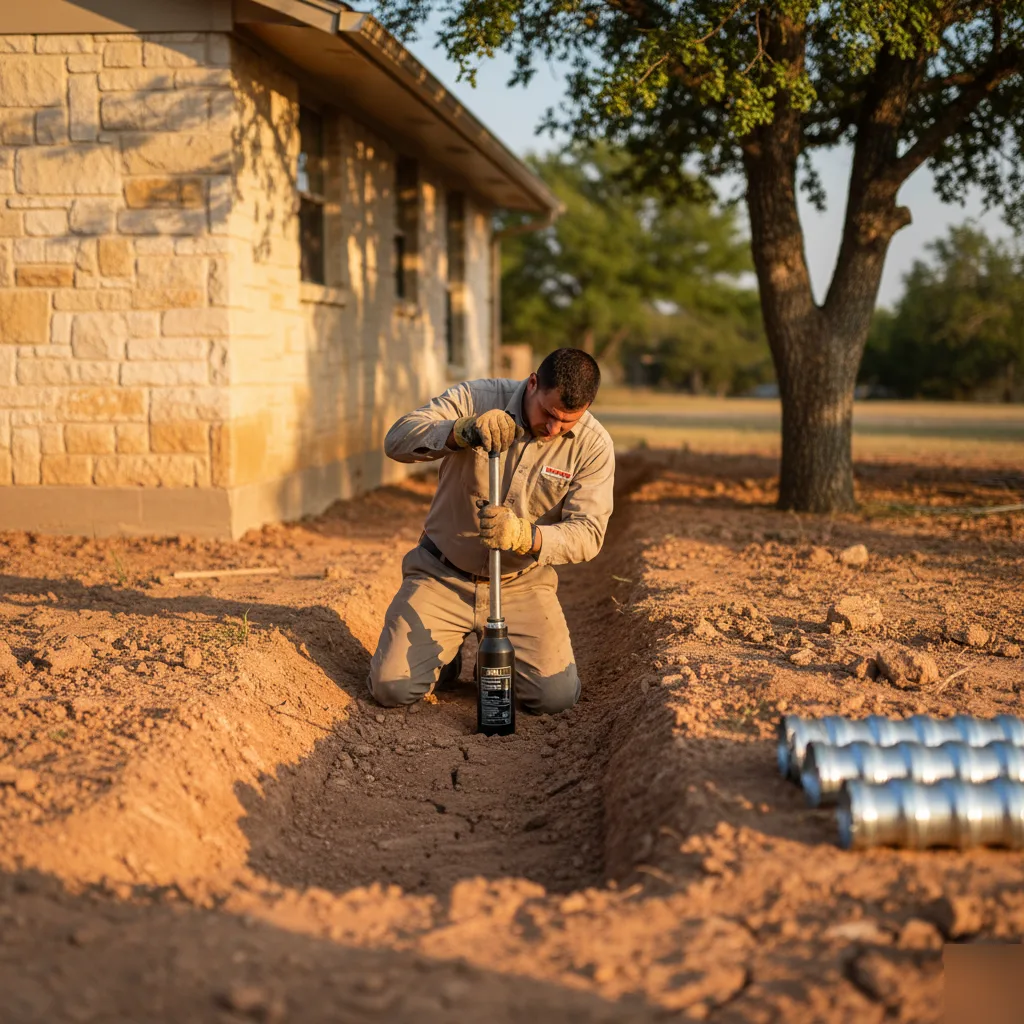
Hydraulic jack pressing a steel pier section beneath an Austin home's foundation
Top to bottom

The Anatomy of a Finished Hybrid Pier

People are sometimes surprised to hear the steel ends up at the bottom. It goes in first, and every concrete cylinder pressed in above it drives the whole column deeper. Reading a finished pier from your foundation down, you'd find the pier head and support assembly, then the stack of 6-inch high-pressure-tested concrete cylinders, then 10 feet of 2⅞-inch steel resting at refusal or bedrock.

And no, that doesn't make it a concrete pier. Traditional pressed concrete piling starts with concrete at the top of the soil profile. The hybrid's initial steel section is the distinction, and it's the part doing the hardest work in Austin's upper clay.

The whole column sits concentrically beneath the grade beam, directly under the structural load, never gripping the foundation from an offset side bracket. We don't use bracketed pier systems on any Bats installation.

On installation day

What Installation Looks Like at Your Home

  1. 1
    Excavate at each pier location

    We open access beneath the grade beam wherever the plan calls for a pier, so each one can be placed concentrically under the load.

  2. 2
    Press the steel lead

    A hydraulic ram, using your home's own weight as resistance, drives the 2⅞-inch steel sections until roughly 10 feet of steel is beneath the foundation.

  3. 3
    Stack the cylinders

    6-inch high-pressure-tested concrete cylinders are pressed in one at a time, each pushing the steel section deeper.

  4. 4
    Drive to refusal or bedrock

    Cylinders keep going until the pier refuses at roughly 10,000 psi of hydraulic system pressure or terminates at rock. Final depth depends on what's under each pier location.

  5. 5
    Lift and lock

    Multiple jacks make coordinated adjustments across the repair area while we monitor elevations and how the structure responds. Steel shims hold the recovered elevation, the jack comes out, a concrete cylinder caps the assembly, and final shims secure it permanently.

One thing we're upfront about: we lift to the limits of the structure and recover what the home will reasonably allow. Promising perfectly level on every house isn't honest, and we'd rather set real expectations before the jacks go in.

Interior movement

When the Problem Is in the Middle of the Slab

Hybrid piers can support interior grade beams too, provided access is practical. Before we open a finished floor, Ground Penetrating Radar maps what's inside and beneath the slab:

  • Interior grade beams and appropriate pier access locations
  • Post-tension cables, before anything cuts near them
  • Reinforcing steel and other embedded components

For significant interior movement we generally prefer a structural pier when one can reasonably be installed. When access, occupancy, or disruption rules it out, polyurethane foam injection is sometimes the less invasive route.

The full picture

Hybrid or All-Steel, Every Project Gets the Same Standards

Our All-Steel Pier System runs steel through the pier's entire driven depth, which makes it the premium option, with cost rising as depth grows. The hybrid delivers a substantial steel section at a lower price. Neither is automatically right for every homeowner, and if both suit your foundation we'll lay out construction, pricing, and warranty differences and let you decide.

Whichever system you choose, a Bats slab foundation repair comes with the same wrap-around standards. Most residential projects take approximately one to three days. Every project receives independent review by a licensed professional engineer, with documentation provided after completion. We require a post-repair hydrostatic plumbing test, performed by an independent licensed plumber, because Bats employs no plumbers and has no financial stake in the result. And we document final elevations once the foundation is adjusted and secured.

The Hybrid Steel Pier System carries a transferable lifetime warranty, with no adjustment charges on covered adjustments for the first 10 years. Full terms come in writing before the project begins. Want to talk it through? Call our Austin office at (512) 260-7182.

Frequently asked questions

Hybrid steel piers in Austin, answered

Why choose hybrid steel piers over an all-steel pier in Austin?

Cost, mostly. The hybrid gives you the same 2⅞-inch steel lead through the upper soils and the same concentric installation beneath the grade beam, but after 10 feet the pier continues with 6-inch high-pressure-tested concrete cylinders instead of more steel. Since you're not paying for steel on every additional foot of depth, the hybrid comes in below our All-Steel Pier. If your foundation suits both, we'll walk you through construction, pricing, and warranty differences and let you pick.

Do hybrid steel piers work in Austin's expansive clay?

Yes, the system was designed around soils like these. Austin clay can expand by 30% or more when saturated, according to the Texas Section of the American Society of Civil Engineers, and most of that movement happens in the upper soil layers. The hybrid pier puts its slim steel section through exactly that zone, then rides out the seasons on concrete cylinders seated at refusal or bedrock far below the active clay.

How deep do the piers have to go?

There's no set number. The steel lead is about 10 feet, and concrete cylinders continue until the pier reaches refusal, generally around 10,000 psi of hydraulic system pressure with our equipment, or hits bedrock first. Depth varies across Austin, sometimes street to street. We can often review depth records from nearby installations to give you realistic context before we start, though they're context, not a promise.

Will the crew have to tear up my house to install interior piers?

Not blindly, no. When interior grade beams need support, we scan the slab with Ground Penetrating Radar first to find grade beams, post-tension cables, and reinforcing steel, and to choose access points. That keeps the openings deliberate and small. Where an interior pier isn't practical, polyurethane foam injection can sometimes handle the problem with less disruption.

How long does hybrid steel pier installation take in Austin?

Most residential slab repairs run approximately one to three days depending on how many piers you need, installation depths, and whether interior access is involved. You can stay home while we work. Afterward, an independent licensed engineer reviews the project and an independent plumber performs a required hydrostatic test.

Is the warranty on hybrid piers transferable if I sell my home?

Yes. The Hybrid Steel Pier System comes with a transferable lifetime warranty, which stays with the structure when it changes hands. Covered adjustments carry no adjustment charge for the first 10 years, and the complete written terms are provided before the project begins.

Get a straight answer about your foundation

We'll take elevations, find the areas that actually need support, and tell you whether the hybrid or all-steel system fits your home better. If it's both, you get the trade-offs and the final call.