

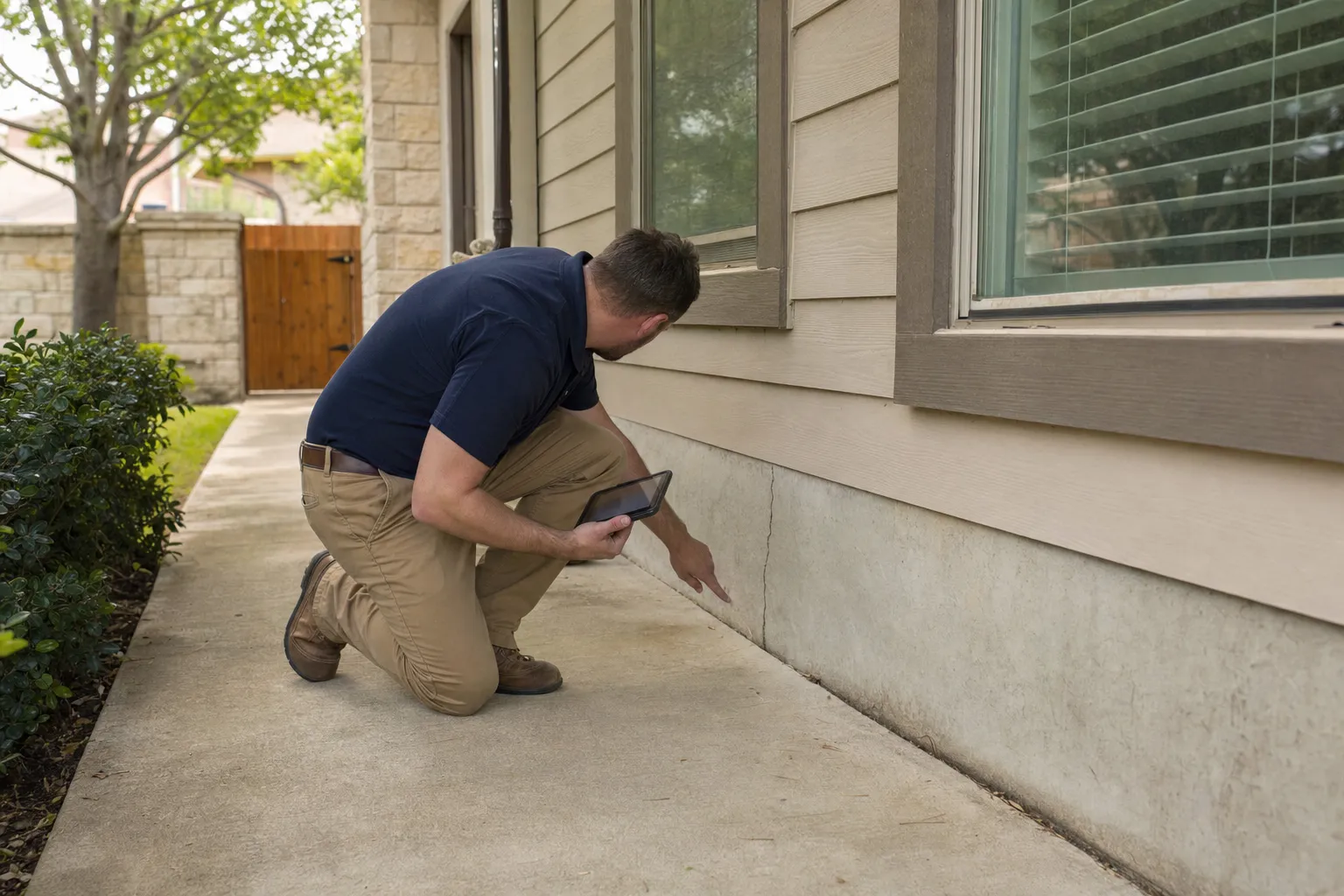
During a concrete slab repair estimate at your Pflugerville home, a technician walks the full property to understand what the soil beneath the slab has been doing, not just what is visible on the surface. We check floors for slope, inspect door and window frames for signs of shifting, and review drainage around the foundation perimeter. In Pflugerville, where homes sit on expansive Blackland Prairie clay that swells when wet and shrinks when dry, that full-picture approach matters. The soil's behavior, not the crack's size, is what drives the repair recommendation. By the end of the visit, you receive a clear explanation of what is causing the damage and which repair method fits your specific situation. No commitment is required on the spot.
What does a concrete slab estimator actually look at during the visit?
A concrete slab estimator examines the entire property, indoors and outdoors, not just the cracks visible from the surface. The goal is to read the full pattern of symptoms before drawing any conclusion about the cause. A single crack in one room doesn't tell us much. The same crack, combined with a sticking back door and a tile grout line that's opened up on the other side of the house — that tells a story.
Our typical inspection sequence runs like this:
- Interior floor survey — We place a level or slope-measuring tool across different rooms to measure how far the floor deviates from level. We compare readings across the home, not just at a single point.
- Door and window frame check — Frames that are out of square, doors that stick or swing open on their own, and gaps at window corners all point to soil movement beneath the slab.
- Exterior drainage review — Water that pools near the foundation or runs toward the house pushes clay soil to swell unevenly. When that soil dries, it shrinks and pulls away from the slab edge.
- Foundation perimeter walkthrough — We look for stair-step cracking in brick veneer, separation at expansion joints, and spots where the slab edge has dropped relative to grade.
- Findings documentation — We record observations so the recommended repair method is tied to specific measurements, not general impressions.
What does the estimator check during the walkthrough?
The estimator takes floor elevation readings across multiple rooms, checks concrete surfaces and soil conditions near the foundation, and uses visual reference points such as door reveals, baseboard gaps, and tile grout lines. No destructive testing is required during the assessment.
Homes in ZIP 78660 were built largely during rapid growth periods in the early-to-mid 2000s and again post-2015. Many sit on minimally prepared clay pads. That makes a full-property read, rather than a quick visual scan, especially important here. It's why we don't send someone out for fifteen minutes and call it done.
Why does soil condition matter more than crack size?
The size of a surface crack tells you less than you might think. What matters is why the crack formed and whether the soil underneath is still moving.
Pflugerville sits on Blackland Prairie clay (Austin Clay / Vertisol series). This soil swells when wet and shrinks when dry. That cyclical movement is the primary cause of slab cracking in the area. A small crack over active, still-shrinking clay can be a bigger problem than a large crack over soil that has stabilized and stopped moving. We've seen hairline cracks that needed real attention and wide ones that didn't. Crack width alone isn't the answer.
Seasonal drought cycles, including the severe 2022 La Niña drought, pull moisture from clay well below normal depth. We ask when cracks appeared and whether their width changes between wet and dry seasons. That seasonal pattern is one of the most useful diagnostic signals we have during an estimate visit.
Large live oaks and cedar elms planted near a foundation pull moisture from the soil during summer months. The localized dry zones those roots create cause one side of the slab to settle faster than another. We call that differential settlement.
How does Pflugerville's clay soil affect slab foundations specifically?
- Expansive clay heaves during wet winters and shrinks during dry summers, stressing the slab repeatedly over time
- The perimeter of a slab typically drops faster than the interior during drought because the perimeter soil dries first
- Homes built quickly on minimally prepared clay pads carry a higher risk of early foundation movement
- June through September historically spikes slab repair inquiries as soil shrinkage peaks under summer heat
Understanding soil behavior lets us match the right repair method to the actual problem. Polyurethane foam injection for a slab that lifted over a void is a very different solution than slab piers for a foundation settling into desiccated clay. Those aren't interchangeable, and you don't want someone who treats them that way.
How long does a concrete slab repair estimate take?
The time required for an on-site slab repair estimate varies depending on the size of the home and the number of areas showing symptoms. More surfaces to check and measure means more readings, and more readings mean a more complete diagnosis.
A portion of that time is spent walking you through what we found in plain language. That explanation is part of the estimate, not an afterthought. Plan to be there so you can point out symptoms you've noticed and ask questions while we're still on site. You've probably been watching some of these cracks for months, and that history matters. We want to hear it.
This isn't a quick visual once-over. It's a structured assessment that produces a clear diagnosis before any repair method is recommended. You leave with a real understanding of what's happening beneath your slab, not just a number on a page.
What repair methods might come up during the estimate conversation?
We explain which repair method fits the specific cause of damage, not a one-size-fits-all recommendation. The diagnosis drives the method, not the other way around.
Polyurethane foam injection is used for sunken garage floors, patios, and driveways where the slab has dropped but the soil beneath is otherwise stable. Lightweight, moisture-resistant foam is injected beneath the slab to fill voids and lift the surface. The area is ready for same-day use after the work is complete.
Pressed concrete piling and pressed steel piling are used when the foundation itself is settling due to ongoing soil shrinkage or movement. Cylindrical pilings are hydraulically pressed section by section to refusal, meaning driven until the soil below offers firm, stable resistance, beneath the slab.
Hybrid steel pier installation is a two-stage system that combines a steel shaft through active upper soils with high-pressure-tested concrete cylinders driven to refusal. This approach suits more complex or severe settlement patterns.
Concrete crack repair and resurfacing address surface-level damage that is not tied to active soil movement. Cracks are filled, stabilized, and the surface is restored to a usable condition.
We recommend foam injection when piers aren't warranted, and we won't recommend resurfacing when the soil beneath is still actively shifting. Putting a cosmetic fix over a moving foundation is something we're not willing to do. All repair plans at Bats Foundation are engineer-reviewed to meet current industry standards.
What is the difference between foam injection and slab piers?
| Polyurethane Foam Injection | Slab Piers (Pressed Concrete or Steel Piling) | |
|---|---|---|
| Best for | Voids, compaction loss, lifted or sunken non-structural slabs | Foundation settlement into shrinking or unstable clay soil |
| Process overview | Foam injected through small drilled ports beneath the slab | Pilings hydraulically pressed to refusal beneath the foundation |
| After-work usability | Same-day use after completion | Varies by scope, confirm with us at time of assessment |
| Warranty | Depends on scope of work | Lifetime transferable warranty on slab pier installations |
The estimate diagnosis determines which of these methods is appropriate. Both are available from our crew in Pflugerville.
What should a homeowner do before the estimator arrives?
A little preparation before the estimate helps us get a more complete picture and saves time during the visit. Run through these before the appointment:
- Walk through the home and note symptoms — Sticking doors, diagonal cracks at wall corners, gaps between baseboard and floor, or uneven tile grout lines are all worth flagging before we arrive.
- Check the exterior for water patterns — Look for spots where water pools near the foundation after rain, downspouts that discharge close to the house, or areas where soil has pulled away from the slab edge.
- Check brick veneer for stair-step cracking — This pattern in the mortar joints is a common sign of differential settlement in Pflugerville's clay soil environment.
- Clear access to problem areas — Move furniture, stored items, or appliances that block any part of the slab we need to inspect.
- Gather previous inspection or repair records — If prior work was done by another contractor or an inspection report exists, having it on hand helps us understand the home's history.
- Note when symptoms first appeared and whether they shift with the seasons — In Pflugerville's clay soil environment, whether a crack opens wider in summer and closes in winter is important diagnostic information.
Does a concrete slab repair estimate in Pflugerville require a permit?
The estimate itself requires no permit. Structural slab repair work in Pflugerville, however, typically does require a permit from the City of Pflugerville or Travis County before work begins.
Unpermitted foundation or structural slab repair can create title and resale complications. In a market where 70% of housing units are owner-occupied and the median home value sits at $335,500, that's a detail worth understanding before any work is scheduled. It's the kind of thing that surfaces during closing, at the worst possible moment, and sorting it out then costs more than the permit ever would have.
Ask directly during the estimate whether a permit is required for the specific repair being recommended. Requirements can vary by scope. What applies to a small concrete crack repair may differ from what is required for a full slab pier installation. Engineer-reviewed repair plans support the permitting process by documenting that the work meets current industry standards.
Homeowners researching their options can review the what your slab repair diagnosis covers and what to expect from the process to better understand what a repair plan may involve before the estimate visit.
This section is informational only. Homeowners should confirm current permit requirements directly with the City of Pflugerville or Travis County before scheduling any structural repair work.
What happens after the estimate is complete?
After the on-site walkthrough, we explain the findings clearly and present a recommended repair approach before leaving the property. You get a real explanation, not a vague summary, of what is causing the damage and why we chose a specific repair method over the alternatives.
There's no pressure to sign anything on the spot. We work on a no-pressure basis, which means you get the information and decide when you're ready. We've been on the other side of a big repair decision, and we know that's how it should go.
Repair plans are engineer-reviewed before work is scheduled, so we're not asking you to commit to anything that hasn't been verified against current industry standards.
For Pflugerville homeowners protecting a median home value of $335,500, understanding the full diagnosis before committing to any repair is a reasonable and expected step. The estimate is designed to give you that understanding, not to rush a decision.
The bottom line
A concrete slab repair estimate is a structured property walkthrough designed to identify what the soil beneath the slab has been doing, not a quick scan of visible cracks. In Pflugerville, where expansive Blackland Prairie clay drives most slab movement, getting the diagnosis right is what separates a repair that holds from one that misses the root cause. You leave the estimate with a clear explanation of the cause, a repair method matched to your specific situation, and no obligation to commit on the spot.