

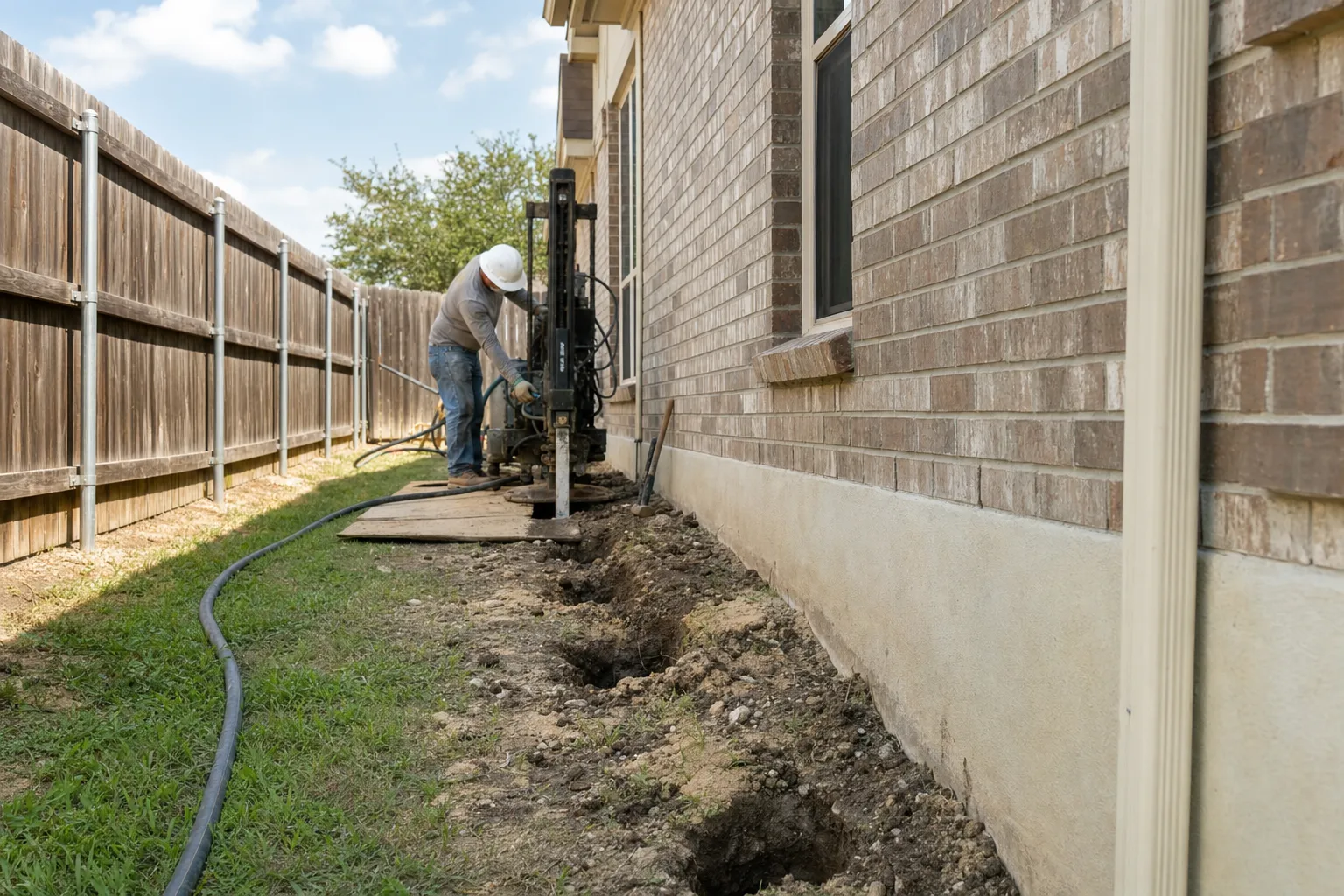
How long does pressed concrete piling installation take in Pflugerville? For most homes, the answer is one day. Pre-cast concrete pilings arrive on-site fully cured, so there's no waiting for concrete to dry. Crews dig small access holes along the foundation perimeter, not large trenches, and use a hydraulic press to drive each piling down through Pflugerville's expansive clay soils until it reaches refusal. Once all piers are set and backfilled, homeowners can typically return to normal activity quickly. Larger projects, interior pier placements, or sites with utility conflicts may extend the timeline, but a standard perimeter job on a Pflugerville slab home is typically a single-day task.
What actually happens during a pressed concrete piling installation?
A crew uses a hydraulic ram to press cylindrical concrete pilings down through Pflugerville's expansive clay soils until each piling reaches refusal, the point where the soil resists further movement and stops the piling from advancing.
The pilings are pre-cast offsite and arrive on the truck fully cured. No wet concrete is mixed at your home, and no concrete is poured into the ground. That's what separates pressed concrete piling work from poured-in-place foundation methods in terms of schedule.
The installation runs in the same order on every job:
- Dig access holes along the foundation perimeter at each planned pier location. These holes are modest in size, enough for the hydraulic press to operate, not full trench excavations.
- Position the hydraulic press over the first access hole and seat the base bracket beneath the foundation edge.
- Press the first piling cylinder downward using hydraulic force. When the first section is nearly flush, a second cylinder is stacked on top and pressing continues.
- Repeat stacking and pressing until the column reaches refusal, the depth at which stable bearing soil stops further penetration.
- Transfer the load by seating the bracket so the foundation bears on the new pier column, then backfill and tamp the access hole before moving to the next location.
What does driven to refusal mean for Pflugerville clay soils?
Refusal means the hydraulic press can no longer advance the piling because the surrounding soil is dense enough to carry the foundation load. In Pflugerville, the soil is Blackland Prairie clay, a Vertisol series that swells when wet and shrinks and cracks when dry. Because this clay shifts seasonally, the depth to stable bearing soil isn't uniform across every lot. One side of a foundation may reach refusal several feet shallower than the other. We see that variation on nearly every job out here, and an experienced crew accounts for it during scheduling.
Why can most Pflugerville jobs be finished in one day?
Because pre-cast pilings are manufactured and fully cured before they ever reach your property, crews can press and set them immediately. No curing window delays the job.
Compare that to poured-in-place concrete piers, which require on-site mixing, pouring into a drilled shaft, and a curing period before the foundation load can transfer to the new piers. That process adds time well beyond the day of installation itself.
Pre-cast concrete pilings are engineered specifically for Central Texas expansive clay conditions. Cylinder sizing and the number of sections needed per pier can be planned from the engineer-reviewed drawings before the truck ever leaves the yard. That advance planning means no guesswork on the day of installation and no surprises that push the work into a second day.
A typical single-family slab in Pflugerville's post-2000 neighborhoods requires a predictable number of perimeter piers. When the pier count is known, crew size and equipment can be matched to the job, keeping the work within a single workday.
Homes with interior pier needs are a different situation. Interior piers require tunneling beneath the slab, a separate process that extends the overall project beyond one day. Large commercial foundations or properties with severe differential settlement across a wide footprint may also require additional days. Our full approach to pressed concrete pilings in Pflugerville covers how we scope those larger projects and what to expect at each phase.
What factors can make a piling installation take longer than one day?
A single day covers most Pflugerville homes, but certain site or foundation conditions extend the schedule. Knowing them in advance helps you plan accurately.
- Higher pier count. Larger home footprints or severe differential settlement may call for more piers than a standard perimeter job. More piers mean more press cycles and more backfill time.
- Interior pier points. Homes needing support beneath the interior slab require tunneling below the foundation. Tunneling is a distinct phase separate from perimeter pier installation.
- Utility conflicts. Underground utilities, gas lines, water supply, irrigation, low-voltage wiring near planned pier locations may require hand-digging or a change in pier placement layout.
- Soil variability. Pflugerville's Blackland Prairie clay can produce inconsistent refusal depths across a single foundation. A pier on one corner may reach stable bearing in fewer cycles than a pier on the opposite side, adding press time overall.
- Access restrictions. Fenced yards, mature landscaping, or tight side yards can slow equipment positioning between pier locations.
- Severe foundation distortion. Foundations with significant differential movement sometimes need careful, staged lifting rather than a single-pass press sequence, which takes additional time.
Does interior foundation repair in Pflugerville take longer?
Yes. Interior piers require crews to tunnel beneath the slab to reach pier points under the home's living area. Tunneling is physically separate from perimeter piling work and is typically scheduled as its own phase. If your engineer-reviewed plan calls for both perimeter and interior piers, expect the overall project to span more than one day.
How does Pflugerville's clay soil affect installation speed?
Pflugerville sits on Blackland Prairie clay, a Vertisol soil that swells when wet and shrinks when dry, and this behavior directly shapes how quickly pilings can be driven to refusal.
During dry seasons, which historically run June through September in Central Texas, clay shrinks and cracks. In some cases, that shrinkage creates shallow voids that allow pilings to advance quickly at upper depths before the cylinder column reaches stable bearing. The press reaches refusal, but the path to get there can be less predictable. We don't always know which it'll be until we're on that specific lot.
After wet periods, saturated clay offers more consistent resistance at upper depths. That resistance can slow the hydraulic press through the first several feet but tends to produce reliable refusal readings once stable bearing soil is reached.
Central Texas experiences prolonged drought cycles that can desiccate clay soils well below normal depth. When that happens, the depth to stable bearing varies more than it would in a region with stable soil moisture. Pre-cast concrete pilings are engineered to perform in expansive clay, so the piling material itself isn't the variable. Depth to refusal is the variable, and it changes lot by lot.
The median home in ZIP 78660 was built around 2007, which means most Pflugerville slab homes are now approximately 17 to 19 years old. Homes in that age range are entering the window where clay-driven differential settlement first becomes visible: sticking doors, diagonal drywall cracks at window corners, and stair-step cracking in brick veneer. Pflugerville is also one of the fastest-growing suburban markets in the Austin MSA, with rapid new construction in the early-to-mid 2000s and again post-2015 producing a large cohort of slab homes built quickly on minimally prepared clay pads, a known risk factor for early foundation movement. Crews who have worked Pflugerville's soil profile for years can anticipate refusal depth ranges for a given neighborhood and schedule accordingly. That kind of local familiarity matters on a job where depth to refusal is the main unknown.
What should homeowners do the day of installation?
Pressed concrete piling installation is minimally disruptive, but a few simple preparations on your end help the crew work efficiently and keep your property in good shape.
- Clear the perimeter. Move vehicles, outdoor furniture, potted plants, and lawn equipment away from the foundation edge before the crew arrives.
- Flag private utility lines. Mark any irrigation lines, low-voltage landscape wiring, or drip tubing running along the foundation edge. The crew will work around publicly marked utilities, but your knowledge of private lines prevents accidental cuts.
- Plan for mechanical noise. The hydraulic press is audible during operation. Working from home that day is possible, but expect intermittent mechanical sound throughout the workday.
- Keep children and pets away from the work perimeter. Active pressing involves hydraulic equipment and open access holes. It's not a safe area for children or animals.
- Expect the access holes to be backfilled before the crew leaves. The yard should be close to its pre-work condition by end of day, with tamped soil filling each hole.
- Plan to return to normal home use once work is complete. Once backfill is tamped, the home is ready for normal activity.
Will the crew need access inside the home?
For perimeter-only piling jobs, the crew typically works outside along the foundation edge. If your engineer-reviewed plan includes interior pier points, the crew will need access to the interior slab for tunneling. Your contractor will tell you which situation applies before the job is scheduled. You shouldn't be finding that out on the morning of.
How does pressed concrete piling installation time compare to other foundation repair methods?
Pressed concrete pilings are among the faster foundation repair methods for Pflugerville homes because no concrete cures on site and excavation is minimal compared to poured pier methods.
Poured-in-place concrete piers require on-site mixing, pouring into a drilled shaft, and a curing period before the foundation load can transfer to the new pier. That adds time beyond the drilling and pouring day itself.
Polyurethane foam injection is also a same-day method for lifting sunken driveways, patios, and garage slabs. But foam injection lifts and stabilizes surface slabs. It doesn't provide deep foundation support under a home's structural slab. The two methods address different problems, and we want to be clear about that distinction.
Pressed steel pilings and hybrid steel piers are also driven section by section to refusal, similar to pressed concrete pilings. The difference is material and design. Your engineer-reviewed plan will specify the right pier type based on your soil conditions and foundation needs.
Tunneling for interior pier access extends overall project time regardless of pier type. Whether the interior piers are pressed concrete, pressed steel, or hybrid steel, the tunneling phase is a separate day or days before the piers themselves are installed.
The one-day speed of pressed concrete pilings comes from the pre-cast manufacturing process. The pilings are fully cured and load-rated before a single cylinder touches your foundation. That's not a shortcut. It's a result of moving the curing time off-site, where it doesn't affect your schedule. The right pier type for your home depends on soil conditions, foundation type, and what your engineer-reviewed plan specifies, not on installation speed alone.
Does Pflugerville require a permit for pressed concrete piling installation?
Structural foundation repair in Pflugerville generally requires a permit from the City of Pflugerville or Travis County, depending on the jurisdiction your property falls under. Homeowners should confirm which applies to their address with their contractor before work begins.
Permits for foundation work exist to protect homeowners. Unpermitted structural repairs can create title complications and disclosure obligations at the time of sale, and that's exactly the kind of thing that surfaces at the worst possible moment, when you're already under contract. In a market where approximately 70 percent of housing units are owner-occupied and median home values in ZIP 78660 sit around $335,500, a permit is a direct protection of resale value, not a formality.
Engineer-reviewed repair plans are part of the structural foundation repair process and are commonly submitted alongside permit applications. Confirm permit requirements directly with your contractor and with the City of Pflugerville's Building and Development Services department before scheduling any structural foundation work.
Does the permit affect how long the installation takes?
No, not the installation day itself. Permit processing happens before installation is scheduled, not during the one-day work window. Homeowners should factor permit lead time into their overall project schedule. The installation still takes one day once all approvals are in place. The permit timeline and the installation timeline are separate and sequential, not overlapping.
The Bottom Line
Most Pflugerville homeowners can expect pressed concrete piling installation to be complete in a single day, with the home ready for normal activity once the work is done. That one-day window is possible because pilings are pre-cast and fully cured before they arrive. No on-site drying is involved. Factors like total pier count, interior access needs, soil variability, and permit lead time can each affect the overall schedule, so a site assessment gives the most accurate picture before any work begins. To see how the full system works and what it takes to protect a Pflugerville slab on Blackland Prairie clay, read our guide to pressed concrete pilings in Pflugerville.