

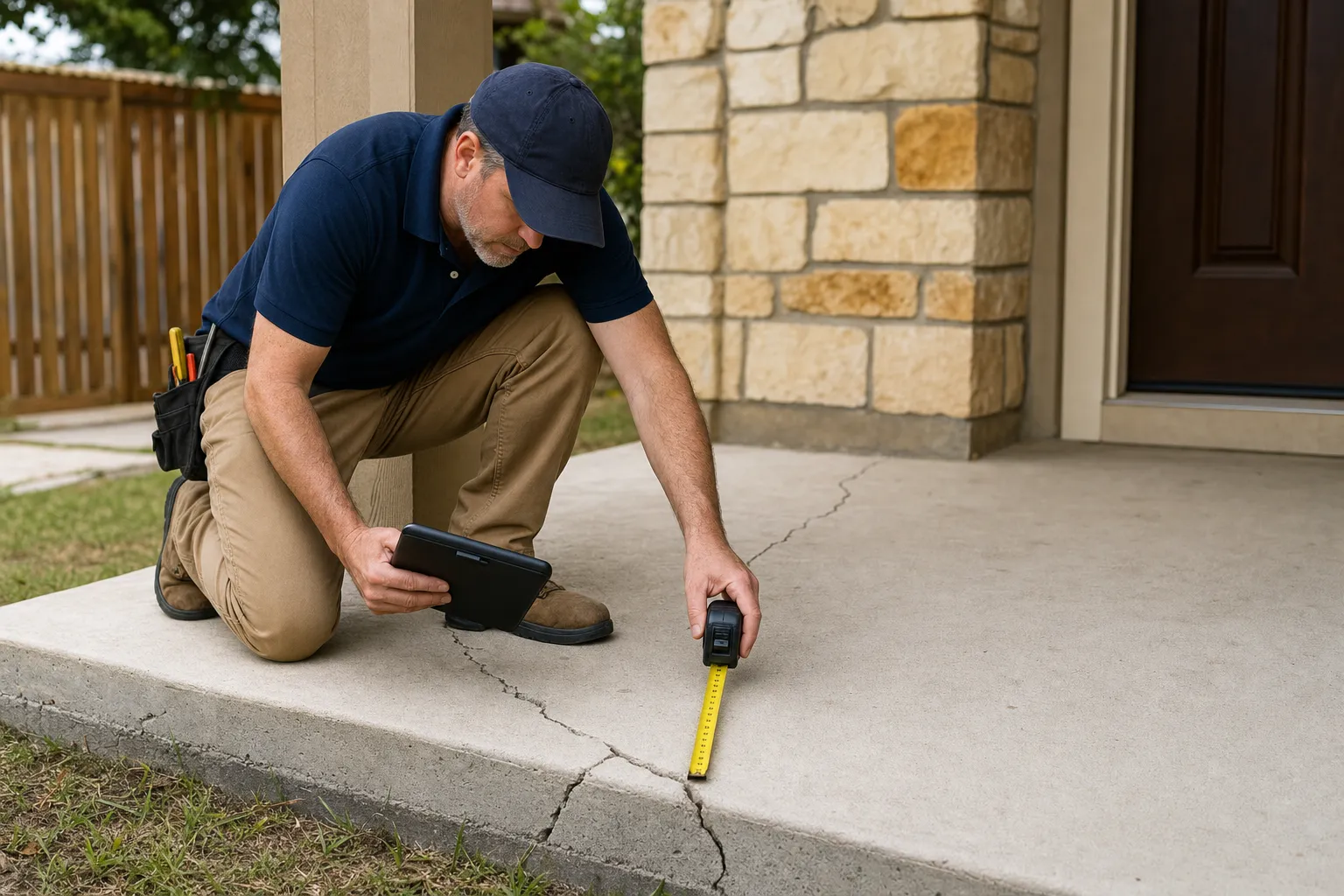
Knowing how to tell if your slab cracks in Pflugerville need professional repair or are just cosmetic comes down to crack width, pattern, and whether other symptoms appear at the same time. Hairline cracks thinner than 1/16 inch are common after concrete cures and rarely signal danger on their own. Cracks wider than a quarter inch, cracks traveling in clusters, or cracks appearing alongside sticking doors and sloping floors suggest real soil movement beneath the slab. Pflugerville sits on Blackland Prairie clay — a soil that swells when wet and shrinks hard when dry — and that seasonal cycle is what turns a surface scratch into a structural warning. When multiple symptoms appear together, get a professional evaluation before the next rain cycle shifts the soil further.
What is a cosmetic slab crack?
A cosmetic slab crack is a surface-level fracture that forms during normal concrete curing and does not reflect movement of the soil beneath the slab. Concrete shrinks slightly as it loses moisture after the pour. That shrinkage produces hairline cracks thinner than 1/16 inch. Predictable byproduct, not a defect.
Cosmetic cracks typically run in straight or gently curved lines. The width stays consistent from one end to the other. They don't grow wider over weeks or months, and they appear without companion symptoms like uneven floors or doors that bind in their frames.
Sealing a cosmetic crack is good maintenance. A penetrating sealer keeps water out and slows the wet-dry cycling that could widen it over time. Not a structural emergency, though.
When you're standing there looking at a crack and trying to decide, these are the things that matter. Cosmetic cracks are thinner than 1/16 inch; structural cracks are wider than 1/4 inch or show vertical displacement. Cosmetic cracks run in consistent, narrow lines; structural cracks cluster, radiate diagonally, or step along mortar joints. Cosmetic cracks appear alone; structural cracks arrive with sticking doors, sloping floors, or gaps at baseboards.
Do hairline cracks in concrete always stay cosmetic?
Hairline cracks can widen over time if left unsealed in wet environments. Pflugerville receives heavy seasonal rain between October and May. Water that enters a hairline crack expands the crack wall slightly each wet-dry cycle, and over several seasons a crack that started at 1/32 inch can open further. Sealing hairline cracks early interrupts that cycle and keeps a cosmetic issue from becoming a monitoring concern — it's one of those small things that's genuinely worth doing.
What makes a slab crack structural rather than cosmetic?
A slab crack becomes structural when it reflects actual movement of the soil or foundation beneath the concrete, not just surface shrinkage. The crack is a symptom of forces acting below the slab — forces the concrete itself can't resolve. Structural cracks are driven by soil heave, differential settlement, or localized drying. Not by the curing process. The concrete responds to those forces by fracturing along its weakest stress lines.
Several things signal that a crack has crossed from cosmetic to structural. A gap wider than a quarter inch means the two sides have separated meaningfully. Vertical displacement — one side sitting higher than the other — means slab sections have moved in different vertical directions. Active growth means the crack is measurably wider this month than last month. And a diagonal path radiating from a door or window corner is a common pattern of differential settlement, where one slab section has dropped relative to an adjacent one.
Post-tension slabs are common in Pflugerville homes built in recent decades. In a post-tension slab, steel tendons run through the concrete under high tension to carry load. A crack that cuts across a tendon cable location warrants immediate professional evaluation. Cable damage changes how structural load distributes across the slab in ways that surface measurements alone can't capture — that's not a situation where waiting and watching makes sense.
Can a structural crack look small on the surface?
Yes. Surface width alone doesn't always reflect the full extent of movement beneath the slab. A professional inspection measures both surface width and any vertical step across the crack to get an accurate picture of what's happening below.
How does Pflugerville's clay soil cause slab cracks in the first place?
Pflugerville sits on Blackland Prairie clay — a soil type that absorbs water and swells, then loses water and shrinks dramatically — and that cycle exerts direct upward and downward pressure on concrete slabs. The USDA soil data for Travis County confirms this area falls within the Austin Clay and Vertisol series, soils classified for high shrink-swell activity.
Between a wet Central Texas winter and a dry summer, this clay can change volume enough to move a slab edge by a measurable fraction of an inch. That movement doesn't happen uniformly. When the perimeter of a slab dries faster than the interior — common during drought — the edges drop while the center stays supported. That creates a "dishing" pattern that opens cracks along the slab's stress lines. The reverse also happens: heavy rain after drought rehydrates clay unevenly, pushing sections of the slab upward and cracking the concrete from below.
Central Texas experienced a severe drought in 2022 that desiccated clay soils well below normal depth. Perimeter edges dropped faster than interiors, producing the sticking doors, diagonal drywall cracks, and brick veneer stair-step cracking that homeowners across the region searched for answers about. We saw it constantly — calls coming in after the first fall rains when homeowners realized the doors that had "always been a little sticky" weren't sticking from humidity anymore.
Homes in ZIP 78660 carry a median build year of around 2007. That makes many local slabs roughly 17 to 19 years old in 2026, exactly the window when post-tension slabs commonly show first signs of differential settlement as surrounding clay begins dry-shrinking beneath the perimeter. Large trees accelerate the problem locally. Live oaks and cedar elms pull soil moisture from the ground near foundations, creating dry zones that cause localized perimeter settlement even in years with normal rainfall. Pflugerville's rapid suburban growth in the early-to-mid 2000s and again post-2015 means a large share of local homes were built quickly on minimally prepared clay pads, a documented risk factor for early foundation movement.
This soil behavior is the starting point for deciding whether professional concrete slab repair in Pflugerville is the right next step, or whether monitoring is enough for now.
What other symptoms appear alongside structural slab cracks?
Structural slab movement rarely stops at the concrete. It transmits upward through the home as sticking doors, sloping floors, gaps at baseboards, and diagonal cracks in drywall. The slab is the base every wall, door frame, and cabinet rests on. When the base moves, everything above it responds — and sometimes those symptoms show up before you ever notice the crack.
Walk through your home and look for these:
Sticking or binding interior doors. The door frame racks slightly out of square as one section of the foundation drops. Doors that stuck only in summer humidity and now stick year-round have crossed a threshold worth paying attention to.
Sloping floors felt underfoot or confirmed with a level. A measurable elevation difference across the slab is a stronger signal than cracks alone.
Diagonal drywall cracks at door and window corners. These follow the path of least resistance when a wall frame is pushed out of plumb by foundation movement.
Brick veneer stair-step cracking along mortar joints. Mortar is weaker than brick, so it cracks first when the foundation shifts. Stair-step patterns in the exterior brick are a common sign in Pflugerville homes.
Gaps opening between baseboards and floor, or between countertops and walls. These gaps indicate two parts of the structure moving in different directions at once.
Cabinet doors that no longer close flush, or drawers that bind. These shifts in the interior millwork reflect the same frame racking that affects door openings.
One symptom in isolation can have a non-foundation explanation. A single sticking door in August humidity is different from a sticking door paired with slab cracks and a measurable floor slope. Multiple symptoms appearing together point toward a professional evaluation more clearly than any one symptom does on its own.
How wide does a slab crack have to be before it needs professional repair?
As a general field benchmark, cracks wider than a quarter inch — about 6 millimeters — warrant professional evaluation. Width alone, however, isn't the only measurement that matters.
Vertical displacement can make a narrower crack more serious than a wider one with no step. A crack that's narrower but has one side sitting noticeably higher than the other reflects more serious movement than a flat, stable crack at a quarter inch. Active growth over time matters just as much. A crack that measured 1/8 inch three months ago and now measures 3/16 inch is actively opening — that growth confirms ongoing soil movement beneath the slab, regardless of current width.
| Crack width | Typical next step |
|---|---|
| Under 1/16 inch | Monitor; seal to keep water out |
| 1/16 inch to 1/4 inch | Monitor closely; document width and date; seal |
| Over 1/4 inch | Professional evaluation |
| Any width with vertical displacement | Professional evaluation regardless of width |
| Any width on a post-tension slab near a tendon | Professional evaluation immediately |
Is there a simple way to tell if a crack is still growing?
Mark each end of the crack with a pencil line and write today's date beside each mark. Check the marks every four to six weeks. If the crack has extended past either mark, it's active. If it's widened, measure again with a ruler and note the new measurement beside the date. Three or more months of stable marks with no widening is a good sign the crack has stopped moving. Any measurable growth is your signal to call a professional rather than continue monitoring.
What crack patterns are the most serious warning signs?
Crack pattern — the shape and direction a crack travels — is often more telling than width alone, because different patterns point to different causes of slab stress. When our crew looks at a crack, the geometry tells us a lot about what the soil is doing below before we even pull out a measuring tape.
Working from least to most urgent:
Random map-cracking — a surface web of fine cracks. Common on garage slabs and patios, usually caused by surface shrinkage during the original pour. Typically cosmetic unless cracks show displacement or are growing.
Straight parallel cracks running with consistent spacing. Often shrinkage-related if narrow and stable. Worth sealing and monitoring, but not always a structural concern.
Parallel cracks running in clusters across a large area. This suggests broad soil movement or widespread shrinkage beneath the slab rather than a single stress point. These need broader evaluation.
Diagonal cracks radiating from door, window, or garage door corners. A common sign of differential settlement, where one corner of the slab has dropped relative to an adjacent section and the concrete has fractured along the diagonal tension line.
Cracks crossing each other at steep angles with vertical displacement at the intersection. Among the most serious patterns we see. The slab is being pushed in multiple directions at once, which means soil movement is coming from more than one location.
What does a diagonal crack near a door corner mean for my foundation?
A diagonal crack at 45 degrees from a door corner is a textbook sign of differential settlement. The door frame corner acts as a stress concentration point. When one part of the slab drops more than the adjacent part, the concrete fractures outward from that corner in a diagonal line. A single diagonal crack at one opening may reflect localized settlement. The same diagonal pattern at multiple openings across the home is a stronger signal that broad foundation movement is underway and needs professional measurement.
When should I stop monitoring and call a professional about slab cracks?
Stop self-monitoring and call a professional when you see any crack wider than a quarter inch, any crack with vertical displacement, or any crack appearing at the same time as sticking doors or sloping floors. Those three conditions together remove doubt about whether monitoring is still appropriate. Honestly, if you're already second-guessing whether to call, that hesitation is worth something — trust it.
Timing matters in Pflugerville. The window between summer drought peak — when soil shrinkage is greatest — and the first heavy fall rains is when foundation movement accelerates fastest. Waiting through another rain cycle can mean the slab shifts further before a professional sees it. Soil that has dried and re-wetted multiple times without evaluation has had multiple opportunities to move in unpredictable directions.
Permits for structural foundation repair work are required by the City of Pflugerville and Travis County in most cases. Unpermitted foundation work can create title and resale complications. With 70% of Pflugerville residents owner-occupants protecting a median home value of $335,500, those resale implications matter. Engineer-reviewed repair plans provide documentation at resale and confirm the repair method fits the specific soil and foundation conditions on that property.
A free, no-pressure foundation assessment removes the risk of calling too early and being oversold on repairs you don't need. At Bats Foundation, if a crack is cosmetic and needs monitoring, we say so — not every crack needs a pier, and we'd rather you hear that from us directly than wonder. Our crew carries 40-plus years of combined experience in Central Texas foundation repair, repair plans are engineer-reviewed to meet current industry standards, and slab pier installations carry a lifetime transferable warranty.
What to take away from this guide
No single measurement tells the whole story. Crack width, vertical displacement, active growth, and companion symptoms together determine whether a slab crack is cosmetic or structural. Pflugerville's Blackland Prairie clay is the underlying driver — seasonal soil swelling and shrinkage is what separates normal concrete behavior from real foundation movement.
Get a professional evaluation any time cracks exceed a quarter inch, show displacement, or appear alongside sticking doors or sloping floors, especially before the next seasonal soil shift. The right next step is an honest assessment of what your slab is actually doing. Learn about repair options and what the free assessment process looks like on our concrete slab repair in Pflugerville page.