

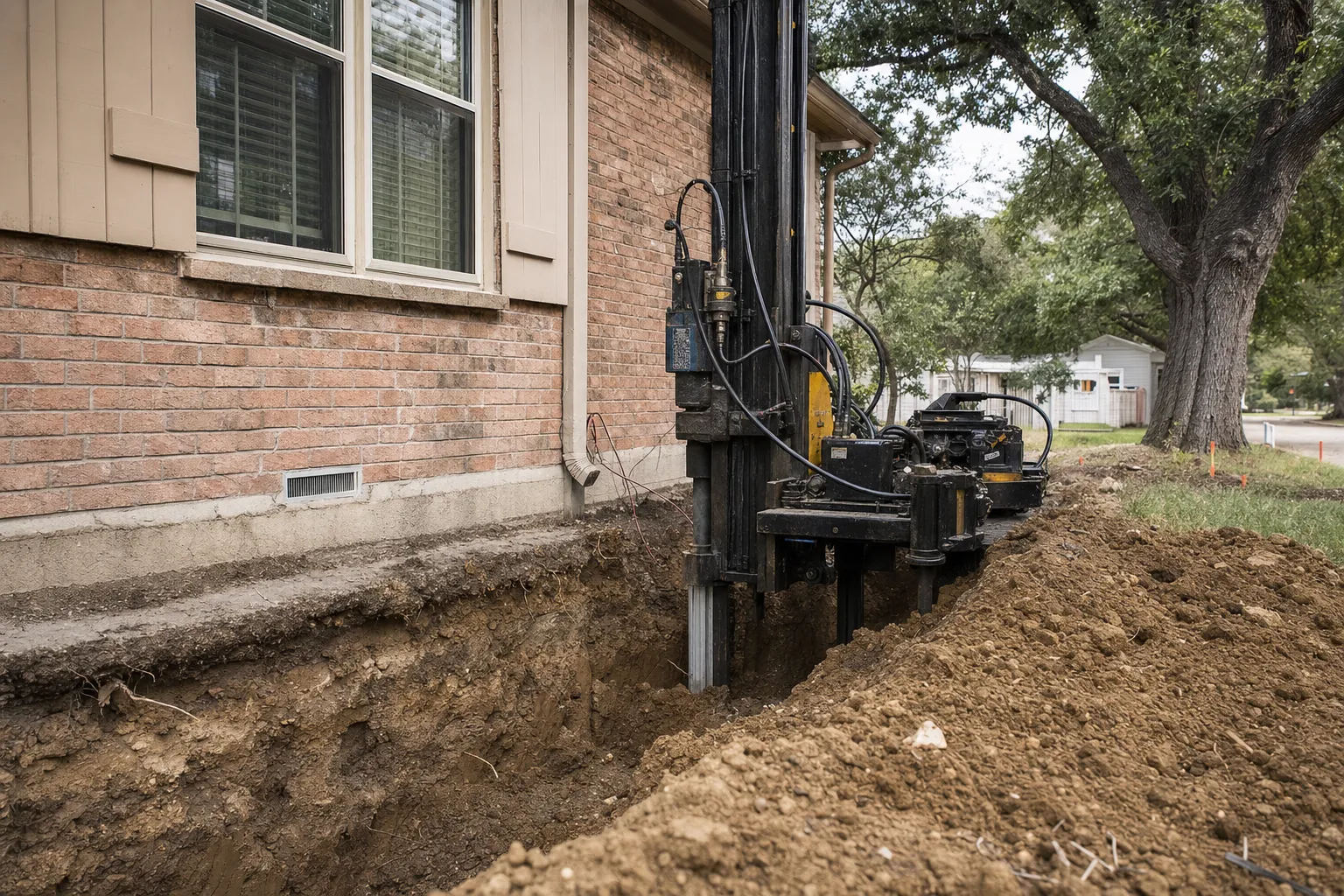
In San Antonio, pressed steel pilings typically need to reach between 15 and 30 feet below the surface to find load-bearing strata. That range exists because Bexar County's expansive clay soil swells when wet and shrinks during drought, making the upper layers unreliable as a foundation base. The question of how deep pressed steel pilings need to go in San Antonio's soil doesn't have a single fixed answer. Depth is determined in real time during installation. Crews press steel sections down one at a time and read hydraulic pressure at each stage. When the pressure spikes and holds, the piling has reached refusal, the point where solid ground resists further advancement. Depth is an outcome of that process, not a number chosen before work begins. Reaching stable strata is what separates a lasting repair from one that moves again.
What type of soil is under San Antonio homes?
Most of San Antonio and Bexar County sits on expansive clay soil, a type that absorbs water and swells, then dries out and contracts with each weather cycle. The word "expansive" describes a physical property: clay particles bond with water molecules and push upward, then pull away from a foundation as moisture leaves the ground. That movement isn't gradual. It can shift a slab noticeably within a single season.
This cycle repeats with every rain and every drought. Near the surface, soil moisture fluctuates constantly, which means the ground itself is rarely in a steady state. A foundation resting in that upper zone is sitting on something that keeps changing shape.
Deeper soil layers are less affected by surface weather. The clay doesn't respond as quickly to rain or dry spells at greater depths, which is why pilings need to pass through the unstable upper zone entirely. Shallow pilings stay inside soil that keeps moving, and a piling tip resting in active clay can't provide a fixed anchor because the clay itself shifts up and down. Getting below that zone isn't a precaution we add for comfort. It's what makes the repair work.
What does 'driven to refusal' mean for pressed steel pilings?
"Driven to refusal" means the piling has been pressed down until the soil or bedrock below physically resists further advancement, and the hydraulic equipment registers a sharp spike in pressure and stops making progress. That spike is the confirmation. It tells the installer that the piling tip has met something solid enough to support the load above it.
The installation process follows a repeating sequence for each piling location. A steel section is positioned beneath the foundation bracket. A hydraulic jack, braced against the foundation itself, applies downward force to the section. Pressure readings on the hydraulic system are monitored continuously. If the section advances without a pressure spike, another section is coupled to the first and we repeat the process. When pressure spikes and holds, refusal is confirmed and pressing stops.
Refusal is measured by pressure readings, not by a number on a ruler. Depth is an outcome of this process, not a preset target written on a work order before we arrive.
Refusal depth also varies by location within San Antonio. One side of a neighborhood can differ from another depending on local geology, and stopping before refusal means the piling tip is still in unstable soil. The hydraulic reading is the only reliable way to know when to stop.
Why does piling depth vary from home to home in San Antonio?
Piling depth varies because stable, load-bearing strata sit at different depths across Bexar County. Soil layers shift based on topography, drainage patterns, and proximity to creek beds or limestone outcroppings near the surface.
The 15-to-30-foot range is a typical window, not a guaranteed stopping point. Some pilings in low-lying areas go deeper before hitting resistance. Others near shallow limestone ledges may reach refusal sooner. The geology beneath San Antonio isn't uniform, and no two homes sit on identical conditions even within the same subdivision.
Prior construction on the site can also affect soil moisture distribution. Underground utilities, old fill dirt, and mature tree root systems all change how water moves through the ground. Roots from large trees draw moisture from the soil, creating drier pockets that affect where active clay gives way to stable ground. Those variables shift the depth at which refusal occurs.
For a closer look at how the installation process accounts for these site-specific factors, the pressed steel pilings in San Antonio service page covers the full process from pre-work assessment through completion.
A free foundation assessment can help identify likely conditions before work begins. When we walk a site, we're looking at visible drainage, tree placement, prior repairs, and crack patterns. That gives you a clearer picture of what the installation is likely to encounter before anyone picks up a tool.
How does San Antonio's drought cycle affect how deep pilings need to go?
Prolonged drought pulls moisture out of clay soil much deeper than normal, drying it out well below the surface and causing the active zone to extend further down than it would in a wetter year. The active zone is the depth range where soil moisture changes seasonally. Pilings must extend below this zone to reach ground that stays stable year-round.
In a severe drought year, the active zone can reach deeper than average. That's one reason we rely on real-time hydraulic pressure readings rather than a fixed depth target. The right stopping point shifts depending on how much the soil has dried out before and during the work.
San Antonio and the surrounding region experience extended dry periods that accelerate clay shrinkage. When the clay dries deeply, the perimeter of a slab drops faster than the interior, producing the classic signs you've probably already noticed: sticking doors, diagonal drywall cracks at corners, and stair-step cracking in brick veneer. A wet year and a drought year can produce different refusal depths on the same property. Pressing to refusal rather than to a fixed number accounts for that variation without us having to guess which condition we're working in.
What happens if pressed steel pilings don't go deep enough?
If pilings stop in the active clay zone instead of reaching stable strata, the foundation they support will continue to move as the soil expands and contracts. The repair doesn't hold. The piling transfers load to soil that's still shifting, so the foundation shifts with it.
The visible consequences appear over the following months or years:
- Doors and windows that stick again in the same spots that were corrected after leveling
- Drywall cracks reappearing at the same diagonal lines near door and window corners
- Visible gaps opening between pier caps and the foundation beam after settlement resumes
The structural consequence is more serious than cosmetic. A piling tip resting in unstable clay can heave upward during a wet season, pushing one section of the foundation higher than another and creating differential movement, a condition where different parts of the slab are at different elevations. That uneven movement causes more cracking than a uniform settlement does.
Refusal confirmation is the industry standard for knowing when to stop. A target depth number without pressure confirmation isn't sufficient. Engineer-reviewed repair plans are one way to verify that depth requirements are being met to current industry standards, rather than to an individual contractor's judgment alone.
How is piling depth confirmed during installation?
Depth is confirmed by monitoring hydraulic pressure during the pressing process. When the reading spikes and holds, the piling tip has met resistance from stable soil or bedrock. That pressure reading is an objective, measurable data point, not an estimate based on experience alone.
Every piling location is confirmed independently. One pier reaching refusal at 18 feet doesn't mean the next pier will stop at the same depth. We track incremental pressure change with each Schedule 80 steel section added, advancing only when the previous section has not yet confirmed resistance.
After all pilings reach refusal, the foundation is lifted using the same hydraulic equipment. The pilings, now anchored to stable ground, act as a fixed base to push against. The lift is controlled and measured at each location to bring the foundation back toward level without overloading any single pier.
When should a San Antonio homeowner consider pressed steel pilings?
Pressed steel pilings are worth considering when a slab foundation has settled unevenly and the cause is soil movement below the surface, not surface drainage problems or plumbing leaks. Those other causes need to be identified and addressed before any pier installation makes sense.
Common signs that point toward foundation settlement include diagonal cracks at the corners of door and window openings, floors that slope noticeably when checked with a level, exterior brick showing stair-step cracking along mortar joints, and interior doors that stick, drag, or no longer latch without force. Sound familiar? We see those combinations regularly on homes in this area, and they're worth taking seriously.
A free foundation assessment is the right first step. We walk through the home, look at the type and pattern of movement, and explain what we're seeing before recommending any repair. That walkthrough helps separate settlement that requires pilings from cosmetic cracking that doesn't. A shrinkage crack in new concrete and a diagonal crack growing at a door corner are different problems, and telling them apart comes down to looking at crack width, direction, location, and whether the crack is still moving. We'll tell you plainly which one you're dealing with.
Homes built on expansive Bexar County clay carry a higher long-term risk of settlement, particularly during extended dry periods when soil shrinkage accelerates. That risk doesn't mean every home will need repairs, but knowing the signs early gives you more options before movement becomes severe. Honestly, we'd rather you call before things get to the point where the repair is more involved than it needed to be.
Pressed steel pilings in San Antonio typically need to reach 15 to 30 feet down, but the real target is refusal, the point where hydraulic pressure confirms stable ground beneath the piling tip. Bexar County clay makes depth a non-negotiable factor, not a rough guideline, because the upper soil layers keep moving with every rain and dry spell. If you're seeing sticking doors, diagonal cracks, or uneven floors, a free, no-pressure on-site assessment is the right starting point before any repair decision is made.