

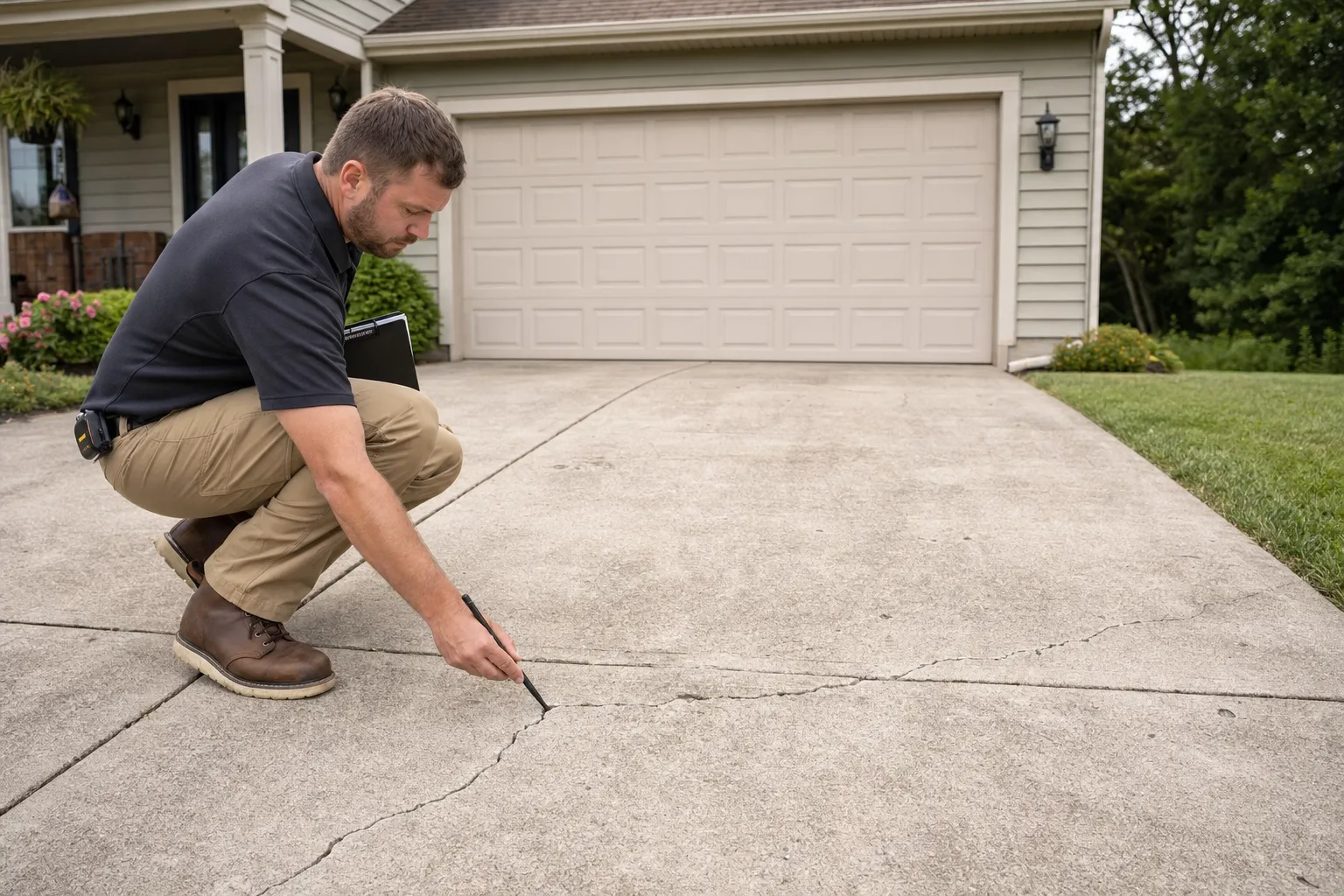
Most cracked driveways can be repaired rather than fully replaced. The answer to "can a cracked driveway be repaired, or does the whole thing need to come out?" really comes down to how much of the slab is still solid and whether a stable base remains underneath. If cracking is isolated to one or two panels and the rest of the concrete is sound, repair methods like foam lifting, crack sealing, or resurfacing almost always make more sense than a full tear-out. Full replacement becomes the better choice when crumbling covers most of the surface or multiple sections have shifted in different directions with no stable base left. A hands-on walkthrough of the driveway is the only reliable way to tell which situation applies to your specific slab.
What causes a concrete driveway to crack in the first place?
Concrete driveways crack most often because the soil beneath them shifts, shrinks, or swells over time. The soil type under the slab matters more than most homeowners realize, and in Central Texas, that soil creates conditions that work against concrete year-round.
How does Central Texas clay soil affect driveways differently than other regions?
Central Texas sits on expansive Blackland Prairie clay, a Vertisol series soil that swells significantly when wet and shrinks and cracks when dry. That cycle of expansion and contraction pushes and pulls the slab from below with every rain event and every dry stretch. It's relentless, and it doesn't stop once the concrete is poured.
Pflugerville homes built in the early-to-mid 2000s often sit on clay pads that were minimally prepared during rapid construction phases. Homes of this age are entering the window where driveways and slab foundations commonly begin showing first signs of differential settlement as surrounding clay soils dry and shift beneath perimeter edges.
Four common causes drive most of the cracks we see. Soil shrinkage and swelling from seasonal moisture changes in Blackland Prairie clay is the most consistent one. Tree root pressure from live oaks and cedar elms that grow beneath slabs and pry panels apart shows up regularly in older Pflugerville neighborhoods. Drainage failure that allows water to pool against the slab edge erodes the base underneath over time. And surface loading from heavy vehicles repeatedly stressing concrete that no longer has full base support accelerates what was already a slow structural problem.
Shrinkage cracks from the original concrete curing process are normal and usually shallow. Settlement cracks that follow a slab panel edge or cross the full width of the driveway are the ones that need a closer look. Understanding the cause tells you whether the problem is cosmetic or structural before any repair conversation begins.
How do you tell if a driveway crack is minor or serious?
Width, depth, and whether one side of the crack sits higher than the other are the three fastest ways to judge crack severity. Those three factors separate a cosmetic surface issue from a structural problem that needs professional attention.
What does a spiderweb crack pattern on a driveway mean?
A spiderweb or map-cracking pattern means stress has spread across the slab surface in multiple directions at once. This pattern typically appears when the concrete itself has weakened, when the base below has eroded unevenly, or when the surface was finished poorly during the original pour. Spiderweb cracks that cover a large area of a single panel often signal that the panel's structural integrity is compromised. We see this pattern fairly often on driveways poured during the construction boom years in Pflugerville, when speed sometimes won out over prep work.
Is a raised edge on a driveway crack a safety or structural problem?
A raised edge on a driveway crack is both. One panel sitting higher than its neighbor creates a trip hazard at the surface and signals that the soil base has shifted unevenly beneath the slab. That kind of differential movement means the problem is structural, not just cosmetic.
Here's a quick way to read what you're seeing:
| Signal | Cosmetic | Structural |
|---|---|---|
| Crack width | Under 1/4 inch | Over 1/4 inch |
| Panel edges | Same level on both sides | One side raised or sunken |
| Crack pattern | Isolated, short | Full-width or spiderweb |
| Movement underfoot | None | Flex or rocking when pressed |
A simple field test: press firmly on each side of the crack while someone else watches from ground level. Visible flex or rocking movement means the base beneath that panel is no longer solid, and repair needs to address what's happening below the surface, not just above it.
When can a cracked driveway be repaired without full replacement?
Repair is the right choice when the concrete slab is still mostly solid and the cracking is limited to one or two isolated areas. When those conditions are met, repair methods restore function at a fraction of the cost and time of a full tear-out.
Can polyurethane foam lifting fix a sunken driveway section?
Yes. Polyurethane foam injection can lift a sunken panel back to grade in a single visit. The foam fills voids beneath the slab, raises the concrete back to its original position, and sets quickly enough that the driveway is usable the same day. Because the foam is lightweight and moisture-resistant, it doesn't add load to the base or trap water the way some fill materials can.
Crack repair and joint sealing stop water from reaching the base layer. Water infiltration is the main driver of future base erosion, so sealing cracks early slows or prevents the kind of settlement that eventually forces a full replacement conversation. Honestly, this is one of those situations where calling earlier saves a lot of money later.
Concrete resurfacing is another option when the slab structure is sound but the surface has become pitted or worn. It bonds a new wear layer over the existing concrete and extends driveway life without removing the slab underneath.
Our guide to cracked driveway repair options for Central Texas homeowners walks through what a professional repair assessment covers, including the specific methods matched to different crack types and base conditions.
If the base is still stable and fewer than roughly half the panels are affected, repair almost always costs less and disrupts the property less than a full tear-out. The key is making sure the repair method actually addresses the root cause and not just the visible surface.
When does a driveway need to be fully replaced instead of repaired?
Full replacement makes more sense when crumbling or spalling covers most of the driveway surface, or when multiple sections have settled in different directions with no stable base remaining. Patching individual cracks in that situation becomes an ongoing cost rather than a lasting fix. We'd rather tell you that upfront than sell you a repair that won't hold.
What is differential settlement and why does it matter for driveways?
Differential settlement happens when different sections of a slab sink at different rates. When one panel drops two inches and the adjacent panel stays level, the joint between them opens, the edges crack, and water gets in. In Pflugerville's clay soil environment, differential settlement is common because clay doesn't dry evenly beneath a slab. Shaded sections stay wet longer while sun-exposed edges dry and shrink faster.
When differential settlement is severe and panels have dropped several inches at different rates, the base typically needs to be excavated and rebuilt before any new surface is poured. Laying fresh concrete over an unstable, uneven base produces a new driveway that'll crack on the same timeline as the old one. That's a lesson we'd rather you not learn the hard way.
Working through the replace-or-repair decision takes four checks. First, look at surface integrity: is the concrete crumbling and flaking across most of the driveway, or is the damage limited to specific cracks? Second, check edge level: do multiple panels sit at different heights relative to each other? Third, test base stability by stepping on sections near the cracks to feel for flex or rocking. Fourth, estimate what percentage of panels are cracked through or visibly sunken. If most of those checks point toward widespread damage, full replacement is the more honest path.
A contractor who walks the driveway with you and explains what they're seeing is more reliable than one who quotes replacement without that on-site check.
How does a concrete contractor assess a cracked driveway?
A proper driveway assessment involves walking every panel, checking for level changes across joints, pressing on suspect areas, and looking at drainage patterns around the slab. Each of those steps gives the contractor a different piece of information about what's happening both above and below the concrete surface.
What questions should a homeowner ask during a driveway assessment?
Good questions to ask include: What is causing this specific crack pattern? Is the base still stable under these panels? Which repair method matches what you are actually seeing here? And: will this repair hold given how the soil moves in this area? You're entitled to real answers to all of them, not just a number on a page.
A no-pressure, free on-site walkthrough lets you see exactly what the contractor sees before any recommendation is made. That transparency matters because the same crack pattern can have two different causes, and the cause determines which repair method will actually hold.
Contractors look for crack width and pattern, differential height between panels, soft spots underfoot, and signs of water pooling near the slab edge. In Pflugerville specifically, we also note proximity to large trees. Live oaks and cedar elms are common moisture-extractors that dry clay soil unevenly beneath a slab, often creating settlement on one side of a driveway while the other side stays stable. Engineer-reviewed repair plans add a layer of verification that the chosen method matches the actual structural conditions found on site. That protects you from both under-repair (missing a base problem) and over-repair (replacing a driveway that only needed sealing).
What repair methods are used on cracked concrete driveways?
The three most common repair methods for cracked driveways are polyurethane foam injection for sunken panels, crack filling and joint sealing for surface fractures, and concrete resurfacing for pitted or worn areas. Each method targets a specific problem, and the right one depends on what the on-site assessment reveals.
Five repair methods come up most often on concrete driveways. Polyurethane foam injection fills voids beneath the slab and lifts settled panels back to grade. The foam is lightweight and moisture-resistant, and the driveway can be used the same day. Crack filling uses a penetrating filler or epoxy compound to bond cracked edges together and stop water from reaching the base layer. Joint sealing closes the expansion joints between panels where water commonly enters and begins eroding the compacted base material. Concrete resurfacing bonds a new wear layer over the existing slab when the structure beneath is sound but the surface is pitted, spalled, or worn. Concrete sealing applies a penetrating sealer to the finished surface to resist moisture and UV damage, slowing the cycle of expansion and contraction that opens cracks wider over time.
None of these methods require a full tear-out when the base and most of the slab are still solid. Choosing the right method means matching the repair to the cause. Sealing a crack that sits above an unstable base won't stop the panel from continuing to sink. Lifting a panel with foam when the concrete itself has crumbled won't give the foam a sound structure to support. Sequence matters too: lifting comes before sealing, and sealing comes before resurfacing. Getting the order right is part of what separates a repair that holds from one that reopens within a season.
How does Pflugerville's soil affect how long driveway repairs last?
Pflugerville sits on expansive Blackland Prairie clay that swells and shrinks with seasonal moisture changes, which means any driveway repair needs to account for ongoing soil movement to hold up long-term. A repair that only addresses the surface without stabilizing the base underneath tends to reopen within a season or two in this soil environment. We see it happen, and it's frustrating for everyone involved.
Why do Pflugerville driveways crack more in summer than in other seasons?
Summer drought months from June through September historically spike soil shrinkage in Central Texas. As clay soils dry out during those months, the ground beneath driveway slabs pulls away from the concrete above. That loss of support causes panels to flex, and hairline cracks that were stable in spring often widen noticeably by August. If you've watched a crack in your driveway seem to grow over a hot summer, that's exactly what's happening.
The median Pflugerville home was built around 2007, putting a large share of the local housing stock at roughly 17 to 19 years old as of 2026. That matters. Homes of this age are entering the window where driveways begin showing first signs of differential settlement as clay soils that were initially compacted during construction have gone through many cycles of wetting and drying.
Adding concrete sealing after a repair slows moisture intrusion into the base. Slower moisture change means less swelling and less shrinking, which reduces the speed at which clay beneath the slab cycles between wet-swollen and dry-contracted states across Central Texas seasons.
Homeowners who plan to sell also have a practical reason to invest in lasting repairs. In a market where roughly 70 percent of households are owner-occupied, driveway condition shows up during buyer walkthroughs. Cosmetic-only fixes that reopen quickly, or unpermitted work that surfaces during title review, can create complications at closing. A repair that addresses the actual cause holds up through both Central Texas summers and real estate transactions.
The clearest path to an honest answer
Most cracked driveways can be repaired rather than replaced. The answer depends on a hands-on look at the specific slab and base conditions, not on the size of the crack alone.
Walking the driveway with a contractor before any recommendation is made gives you the clearest picture of what's actually happening beneath the surface. You see what we see, you hear the reasoning, and you make the decision from an informed position rather than a quote on a piece of paper.
If you're ready to find out which situation your driveway falls into, schedule a free, no-pressure on-site assessment with our team. We walk every panel with you and show you exactly what we're seeing before recommending anything.